
1. Why Quartz Dominates the Kitchen Countertop Market
If you have spent any meaningful time in the countertop trade over the last decade, you have watched engineered quartz steadily overtake every competing surface material in kitchen applications. This is not a marginal shift—it is a structural realignment of the entire market. Data from Freedonia Group market studies shows global demand for quartz surfaces surpassing USD 15 billion in 2023, with kitchen countertops representing the single largest application segment. The National Kitchen & Bath Association (NKBA) annual design trends survey has ranked quartz as the number-one countertop material specified by kitchen designers every year since 2017, and that lead keeps widening.
What is driving this dominance? It comes down to a convergence of performance, aesthetics, and commercial value that no competing material can match simultaneously.
The Performance Argument
Engineered quartz is composed of approximately 93 % crushed natural quartz bound with roughly 7 % polymer resins, pigments, and performance additives. This engineered composition yields a surface with a Mohs hardness of 7—harder than a steel knife blade—a water absorption rate below 0.02 %, and virtually zero porosity. In a kitchen environment, where countertops face daily exposure to coffee, red wine, lemon juice, olive oil, turmeric, tomato paste, and every other staining agent a household can produce, this non-porous characteristic is not a nice-to-have; it is a requirement.
Unlike natural granite, which must be sealed every 12–24 months to maintain its stain resistance, and unlike marble, which etches almost on contact with citric acid, quartz demands no sealing, no specialty cleaning products, and no periodic reconditioning. A damp cloth and mild soap are genuinely all it needs. For end users this means fewer headaches; for B2B distributors and fabricators it means dramatically fewer warranty call-backs.
Scratch resistance deserves a specific note. Quartz will not be damaged under normal kitchen use—sliding plates, chopping vegetables, setting down glasses. However, materials of equal or greater hardness can leave marks: ceramic dishes dragged aggressively, abrasive cleaning pads, or concentrated sand particles. Advise downstream customers to recommend cutting boards—not because the knife harms the quartz, but because the quartz will dull the knife.
Heat Resistance: Know the Limits
This is the one area where buyers need precise, honest information. Quartz countertops can tolerate brief contact with moderately hot objects, but they are not as heat-resistant as natural granite or sintered stone. The resin binder begins to discolor, crack, or delaminate at sustained temperatures above approximately 150 °C (300 °F). Placing a hot pot directly from a gas burner onto the quartz surface is the single most common cause of warranty claims in kitchen installations—a preventable issue if trivets and hot pads are used consistently. B2B buyers should make certain their downstream customers communicate this clearly at point of sale.
The Aesthetic Revolution
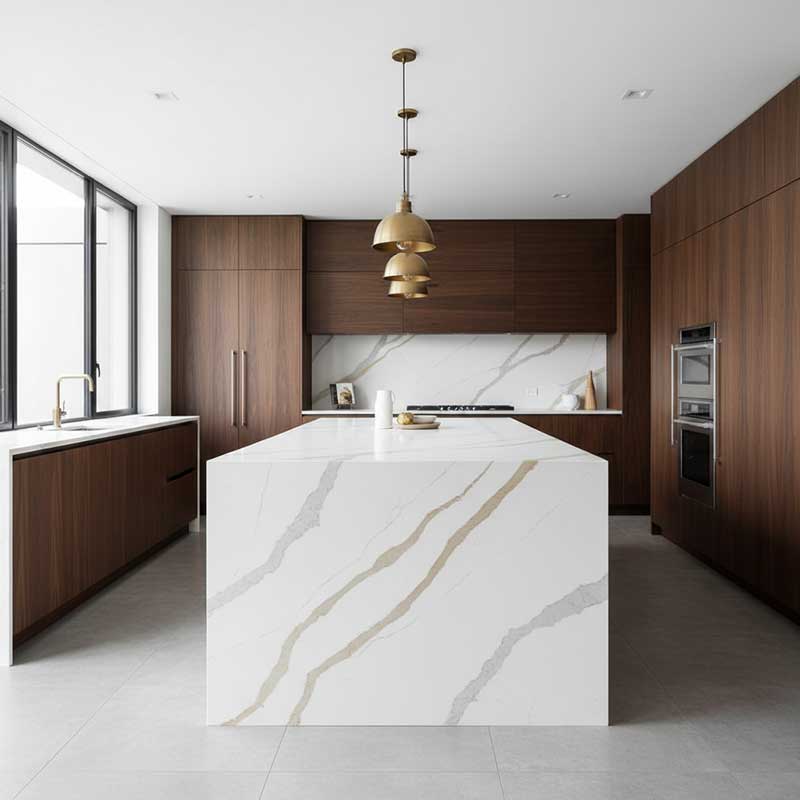
Modern quartz manufacturing has reached a level of visual sophistication that was unimaginable fifteen years ago. The introduction of large-format veining technology—systems developed by press manufacturers like Breton S.p.A. and others—enables factories to produce full-slab designs with through-body veining that closely replicates the appearance of natural Italian marble. A well-executed Calacatta quartz slab, viewed from a normal distance under typical residential lighting, is virtually indistinguishable from natural Calacatta marble. The difference becomes apparent only under close tactile inspection or deliberate side-by-side comparison.
For B2B buyers, this aesthetic capability is the single biggest commercial opportunity in the category. Natural Calacatta marble wholesales at USD 80–200+ per square metre depending on grade and quarry of origin, requires periodic sealing, etches on acid contact, and carries inherent consistency risks—every natural slab is unique, which sounds appealing until your customer rejects a delivery because the veining does not match the showroom sample. Quartz replicates the look at USD 40–80 per square metre wholesale (CIF from China), requires zero maintenance, and offers batch-to-batch consistency that natural stone simply cannot deliver. Higher margins, lower claims, happier end customers.
How Quartz Compares to Other Engineered Alternatives
Solid surface materials (acrylic-based products like Corian) provide similar non-porosity and design consistency, but they lack the hardness, heat tolerance, and natural-stone aesthetic that today's consumers expect. They scratch more easily and cannot convincingly replicate marble veining at full-slab scale.
Sintered stone and ultra-compact surfaces (such as Dekton by Cosentino) represent the most credible emerging competitor. They offer excellent heat resistance, UV stability, and scratch resistance. But sintered stone is more brittle, harder to fabricate (requiring specialised CNC equipment and diamond tooling), and considerably more expensive at wholesale. Its market share in kitchen countertops remains below 5 % globally.
Laminate countertops still dominate the economy tier but cannot compete on durability, perceived quality, or the resale value they contribute to a home. For builders and developers targeting any market segment above entry-level, quartz has become the default specification.
The bottom line for importers and distributors: quartz's combination of durability, aesthetics, consistency, and cost-effectiveness makes it the highest-volume, most commercially reliable product category for any countertop business focused on kitchen applications.
2. Standard Slab Sizes for Kitchen Countertops
Getting slab sizes right is one of those behind-the-scenes details that separates experienced importers from newcomers. It affects material yield—how much usable countertop you extract from each slab—waste percentages, container loading efficiency, and ultimately profit margin per project. Chinese quartz manufacturers have largely standardised around a handful of key dimensions, though slight variations exist between factories depending on their press equipment.
| Slab Designation | Nominal Size (mm) | Area per Slab | Typical Application |
|---|---|---|---|
| Standard | 3200 × 1600 | 5.12 m² | Most kitchen countertops; best all-round option |
| Standard Alt. | 3000 × 1400 | 4.20 m² | Common alternative; slightly lower yield per slab |
| Jumbo | 3200 × 1800 | 5.76 m² | Large islands, premium projects requiring fewer seams |
| Super Jumbo | 3400 × 1800 | 6.12 m² | Ultra-premium; limited factory availability |
| Economy | 2400 × 1200 | 2.88 m² | Small countertops, vanity tops, cost-sensitive jobs |
| Prefabricated | Custom cut-to-size | Varies | Builder-grade, multi-family housing, ready-to-install |
The 3200 × 1600 mm Workhorse
If you are building your first inventory or establishing a new supplier relationship, this is the slab size to start with. It provides approximately 5.12 square metres of material and accommodates the vast majority of standard residential kitchen layouts with acceptable waste.
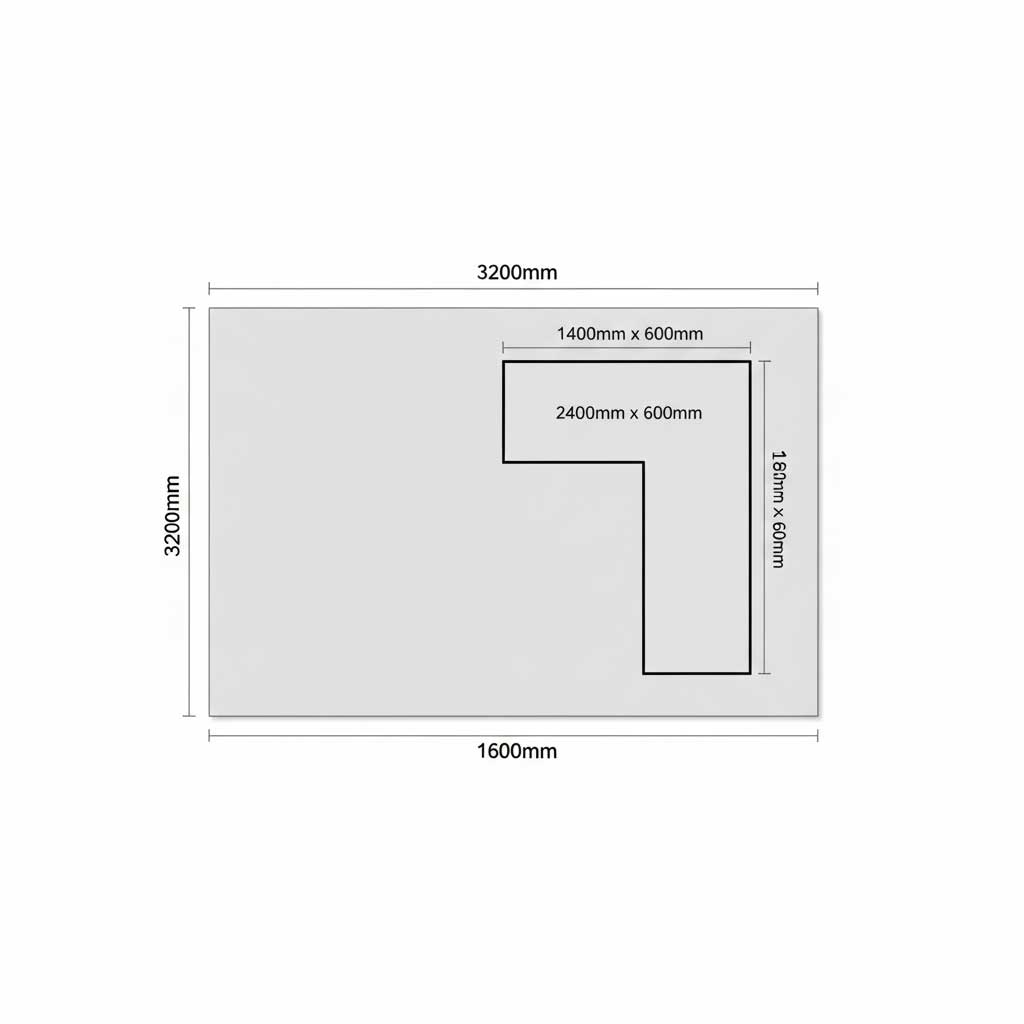
To put this in practical terms: a typical straight-run kitchen countertop in most markets is 2400–3000 mm long and 600 mm deep. A single 3200 × 1600 mm slab can yield one full-length countertop run plus a second piece from the remaining width—or alternatively, an L-shaped layout can often be cut from a single slab when dimensions are planned carefully. Experienced fabricators typically achieve 75–85 % material yield from standard slabs on kitchen countertop projects, meaning 15–25 % waste. This yield rate is meaningfully better than natural granite, which averages 25–40 % waste due to natural defects, colour matching requirements, and irregular block shapes.
Jumbo Slabs for Seamless Islands
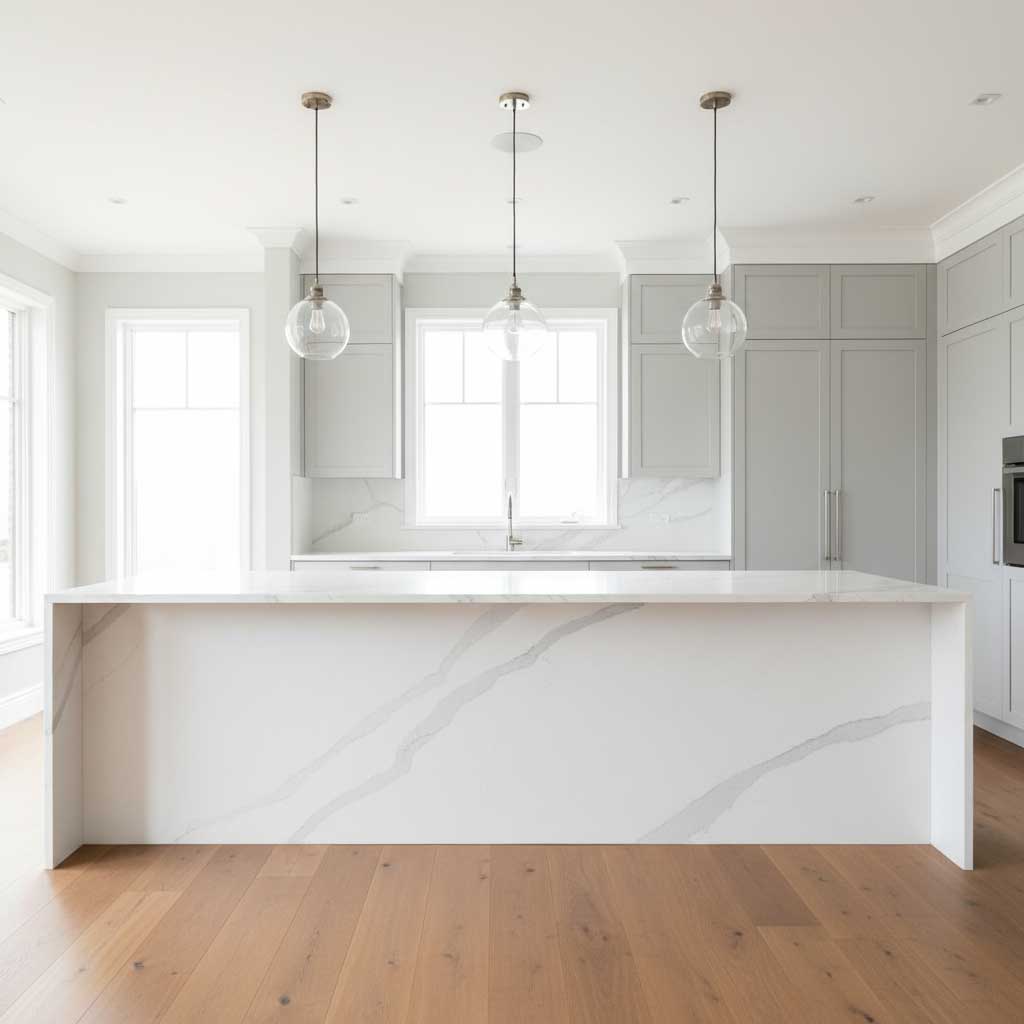
The trend toward larger kitchen islands—3000 mm and beyond in length—has pushed demand for jumbo slab sizes upward year after year. According to NKBA survey data, the average kitchen island in new North American construction has grown from roughly 1800 mm to over 2400 mm in length during the past decade, and depths of 1000–1200 mm are now common for islands that incorporate seating on one side.
A 3200 × 1800 mm jumbo slab allows fabricators to cut oversized island tops as a single piece, eliminating visible seams entirely. For B2B buyers serving the premium residential and luxury hospitality segments, offering jumbo slabs is an important product differentiation strategy. Keep in mind that not every factory can produce genuine jumbo slabs—it requires press equipment rated for the larger format. Some factories may offer to "splice" two standard slabs into a jumbo-sized piece; this is not the same thing. A genuinely pressed jumbo slab has continuous structural integrity, while a spliced slab has a bonded joint that may be visible and represents a structural weakness point. Always verify press capacity when qualifying a jumbo-slab supplier.
Jumbo slabs typically require higher MOQs (minimum order quantities)—often 50–100 slabs per colour versus 20–30 for standard sizes—and may carry a 5–15 % price premium over the standard equivalent.
A standard 20-foot container typically accommodates 8–10 bundles of 3200 × 1600 mm slabs at 20 mm thickness. Each bundle holds 3–5 slabs depending on packaging method, giving a total of roughly 24–50 slabs per container (approximately 120–250 square metres of material). A 40-foot container doubles this capacity. Always confirm your manufacturer's specific packing arrangement when calculating order quantities, as bundle size and crating dimensions vary between factories.
Prefabricated Countertops for Volume Projects
Prefabricated (pre-cut, pre-polished) countertop pieces are a growing segment, particularly for the builder and multi-family housing markets. Instead of shipping full slabs that require local fabrication, some importers are sourcing ready-to-install countertop pieces in standard dimensions—for example, 2440 × 635 mm (96″ × 25″) straight runs or 1220 × 635 mm (48″ × 25″) end pieces—with edges already profiled and sink cutouts already made at the factory.
This approach eliminates local fabrication cost (which can represent 30–50 % of the total installed cost), reduces lead time from order to installation, and simplifies project logistics for large-volume jobs. The trade-off is inflexibility: prefab works only when kitchen layouts are standardised and dimensions are known in advance. It is most effective for apartment complexes, tract-housing developments, and hotel renovations where hundreds of identical units need the same countertop configuration.
3. Thickness Options: 20 mm vs 30 mm
For kitchen countertops, the thickness decision comes down to two practical options—20 mm and 30 mm—each serving different market expectations and price points. (Thinner options like 12 mm and 15 mm exist but are used primarily for wall cladding and backsplash applications, not as load-bearing kitchen worksurfaces.)
20 mm — The Global Standard
If no thickness is specified in a purchase order, 20 mm is what your customer expects. It is the default kitchen countertop specification in Europe, Asia-Pacific, Latin America, the Middle East, and increasingly in North America as well. It accounts for roughly 80 % of residential kitchen quartz installations worldwide.
Structurally, 20 mm quartz delivers a flexural strength in the range of 40–60 MPa (depending on formulation), which is more than adequate for typical kitchen installations where the countertop rests on standard base cabinets spaced at 560–600 mm depth. The 20 mm edge creates a clean, contemporary line—thin enough to feel modern, substantial enough to communicate quality. For B2B buyers building stock inventory, 20 mm is the safest, most versatile choice.
Weight is a practical consideration that matters more than many buyers realise. A 20 mm quartz slab at 3200 × 1600 mm weighs approximately 245 kg (at a typical density of 2.4 g/cm³). A 30 mm slab of the same dimensions weighs approximately 369 kg. That weight difference compounds at every stage—handling in the factory, loading containers, unloading at the warehouse, transporting to the fabrication shop, and final installation. More slabs per container, easier handling, lower breakage risk—these all favour 20 mm for volume operations.
30 mm — The Premium Specification
In the North American market, where the 1¼-inch countertop has been the traditional standard since the era of granite dominance, 30 mm quartz is the expected specification for mid-range to high-end residential kitchens. If you are distributing primarily into the US or Canadian market and you offer only 20 mm, you will lose bids to competitors who stock 30 mm.
In European and Asian markets, 30 mm communicates luxury. It is specified for high-end residential projects and premium commercial spaces (boutique hotels, upscale restaurants) where the thicker edge conveys substance and permanence. The additional cost is perceived as justified by the visual weight of the finished countertop.
The factory price premium for 30 mm over 20 mm is typically 30–45 %, which is less than the 50 % increase in raw material because the pressing and curing process cost is largely fixed regardless of slab thickness. The real cost impact for importers is in logistics: fewer 30 mm slabs fit in a container (due to both weight and volume), and handling costs increase at every touchpoint.
The Laminated Edge Technique
There is a widely used fabrication technique that bridges the gap between 20 mm economy and the appearance of a thicker edge. Fabricators bond a strip of matching 20 mm quartz beneath the front edge of a 20 mm slab, creating the visual appearance of a 40 mm edge while maintaining the lighter weight and lower material cost. Some fabricators extend this to create 60 mm "chunky" edges for ultra-contemporary designs.
As a B2B supplier, understanding this technique is commercially valuable because it allows you to sell 20 mm slabs into projects that want a thick-edge look. You are selling the same product at the same price, but with a fabrication recommendation that adds significant perceived value at the retail level.
4. Edge Profiles: From Eased to Waterfall
The edge profile is where a flat slab becomes a finished countertop. It is the detail that end users see and touch daily, and it has an outsized influence on perceived quality and design intent. While edge fabrication is nearly always performed by local fabricators rather than at the factory in China, B2B buyers who understand edge options sell more effectively because they can guide their downstream customers toward higher-value configurations.
| Edge Profile | Description | Design Style | Popularity |
|---|---|---|---|
| Flat / Eased | Straight cut with slight rounding on top corners | Contemporary, minimalist | ★★★★★ |
| Beveled | Angled cut (usually 45°) along the top edge | Modern, transitional | ★★★★☆ |
| Half Bullnose | Rounded on the top edge, flat on the bottom | Traditional, soft | ★★★☆☆ |
| Full Bullnose | Completely rounded on top and bottom | Traditional, classic | ★★☆☆☆ |
| Ogee | Decorative S-shaped curve | Ornate, traditional | ★★☆☆☆ |
| Waterfall | Countertop continues vertically down the side to the floor | Ultra-contemporary, luxury | ★★★★☆ (growing fast) |
| Mitered | Two slabs joined at 45° to create thick-edge appearance | Modern, premium | ★★★☆☆ |
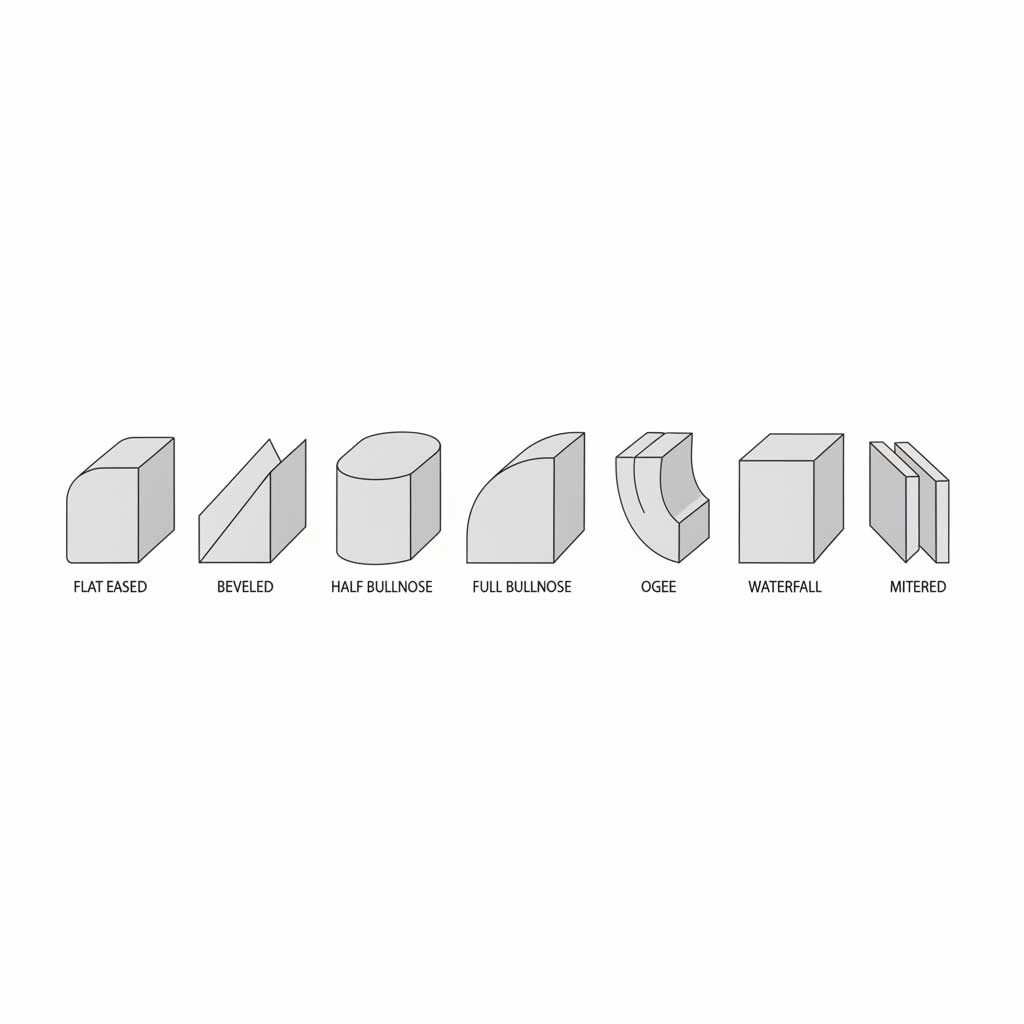
The flat (eased) edge accounts for the majority of kitchen installations because it aligns perfectly with the clean, minimalist aesthetic that dominates contemporary design. It is also the least expensive edge to fabricate—a simple straight cut with a gentle easing of the sharp top corners to prevent chipping and make the edge safe to lean against. If you are selling into volume markets, the vast majority of your slabs will receive this treatment.
Waterfall Edge — The Trending Premium Detail
The waterfall edge has become one of the most requested premium design elements in residential kitchen design. In a waterfall installation, the quartz surface extends vertically from the countertop plane down to the floor on one or both ends of a kitchen island. The result is a continuous cascade of stone that wraps from horizontal to vertical, producing a dramatic architectural statement that elevates the island into the centrepiece of the kitchen.
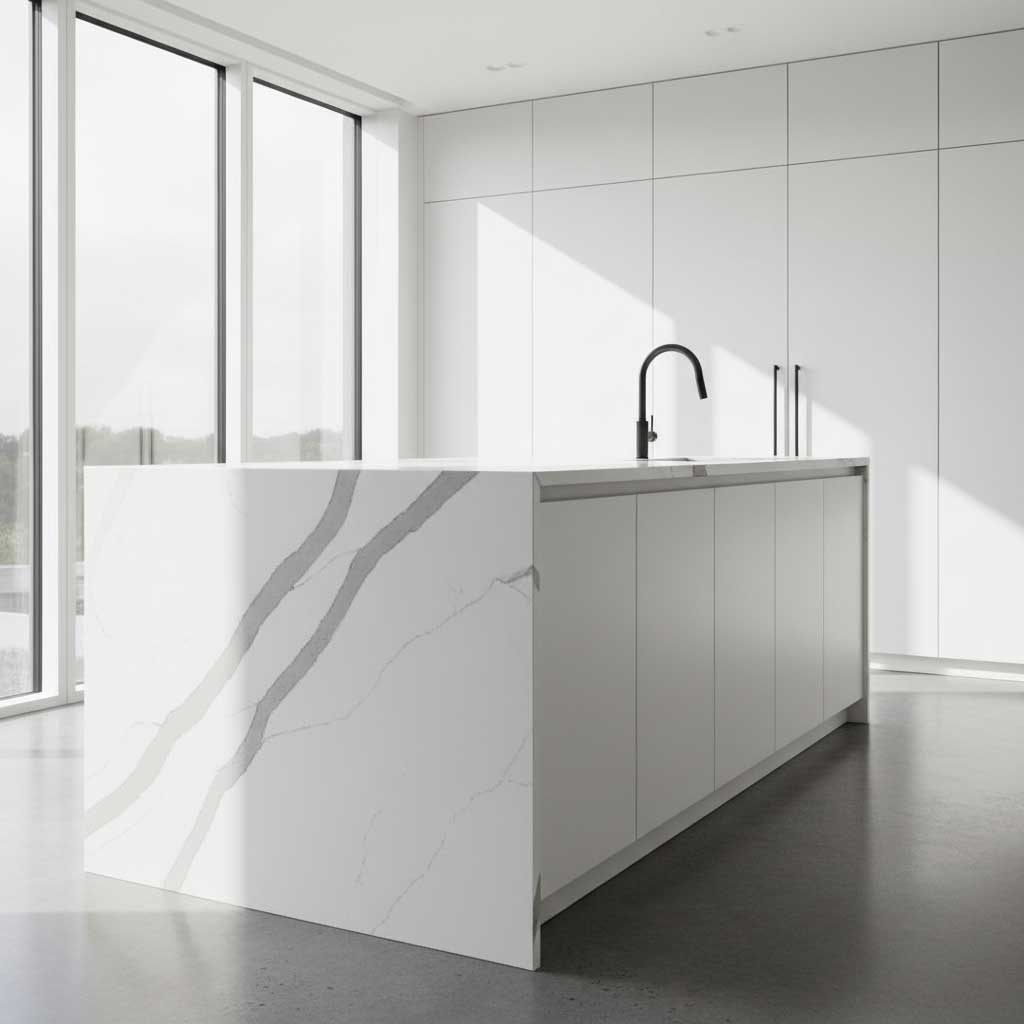
From a material standpoint, a waterfall end requires additional quartz—typically one extra cut per island side, sized to the countertop height (usually around 900 mm) by the countertop depth (600 mm). Each waterfall panel therefore uses roughly 0.54 m² of material. For an island with waterfall edges on both ends, that is approximately 1.08 m² of additional material per project. This represents meaningful incremental sales for every waterfall island job your fabricators produce.
The critical fabrication detail in a waterfall installation is the 45-degree miter joint where the horizontal countertop meets the vertical panel. The joint must be precisely cut and bonded with colour-matched epoxy so that the surface pattern—particularly veining—flows continuously from one plane to the other. This is skilled work, and a poorly executed miter joint is immediately visible. When selling quartz for waterfall applications, emphasise the importance of pattern matching at the joint, especially with directional vein designs such as Calacatta or Statuario. You can see examples of well-executed waterfall installations in the QuartzCrafts kitchen project gallery, which features a range of real-world kitchen applications.
Mitered Edges for Perceived Thickness
Mitered edges use the same 45-degree joining principle but for a different purpose: creating the appearance of a thicker countertop edge without requiring heavier (and costlier) solid slabs. A 20 mm slab with a mitered edge strip produces a 40 mm or 60 mm edge profile that looks substantial and feels premium, at a fraction of the cost and weight of solid 40 mm or 60 mm material (which does not exist as a standard production option anyway). This technique is popular in commercial fit-outs—hotel lobbies, restaurant bars, reception desks—where a massive edge profile is part of the design language.
5. Popular Colours and Market Trends for 2025
Colour selection is arguably the most consequential commercial decision in quartz countertop distribution. Stock the right colours, and your inventory turns quickly with healthy margins. Stock the wrong ones, and you find yourself discounting dead stock twelve months later. The good news is that kitchen countertop colour preferences are far more stable than fashion trends—shifts happen on 3–5 year cycles, and core categories remain consistent even as specific designs evolve within them.
For the 2024–2025 period, the category breakdown of global kitchen countertop demand looks roughly as follows, based on our own sales data and patterns reflected in trend reports from platforms like Houzz and the NKBA:
Marble-Look Whites — 40–50 % of Global Demand
White-based quartz with marble-inspired veining continues to be the single largest category, a position it has held since roughly 2016 with no sign of weakening. If anything, the category has become more nuanced as manufacturing technology has advanced—the range of available marble-look designs is broader and more sophisticated than ever.
Calacatta Gold remains the single most requested design globally. Its warm gold-toned veining on a bright white background creates a luxurious, inviting aesthetic that works across virtually every kitchen style from sleek contemporary to relaxed transitional. If you are stocking only one marble-look design, this should be it.
Calacatta Classic / Calacatta Bold designs featuring prominent grey veining on a white ground appeal to buyers who want a more dramatic, high-contrast look. These are particularly effective on large islands and as backsplash material, where the bold pattern creates a genuine focal point. Manufacturers like QuartzCrafts offer several variations in this category, from subtle to highly dramatic, giving distributors the range they need to cover different market segments within a single colour family.
Carrara-inspired designs with softer, more diffuse grey veining occupy the gentler end of the marble spectrum. They are less dramatic than Calacatta but more versatile—less likely to compete with other visual elements in a busy kitchen. Carrara-style quartz sells particularly well in European markets, where restrained elegance tends to outperform bold pattern work.
Statuario designs with distinctive elongated grey veining on a slightly warmer white background round out the marble-look white family. Statuario is frequently specified for traditional or transitional kitchen styles and for larger format applications where the longer vein structures can express themselves fully.
For B2B buyers, stock at least 6–8 variations within the marble-look white category—enough to range from subtle Carrara through to bold Calacatta, with variety in vein scale, vein direction, and colour temperature (warm gold undertone versus cool blue-grey undertone).
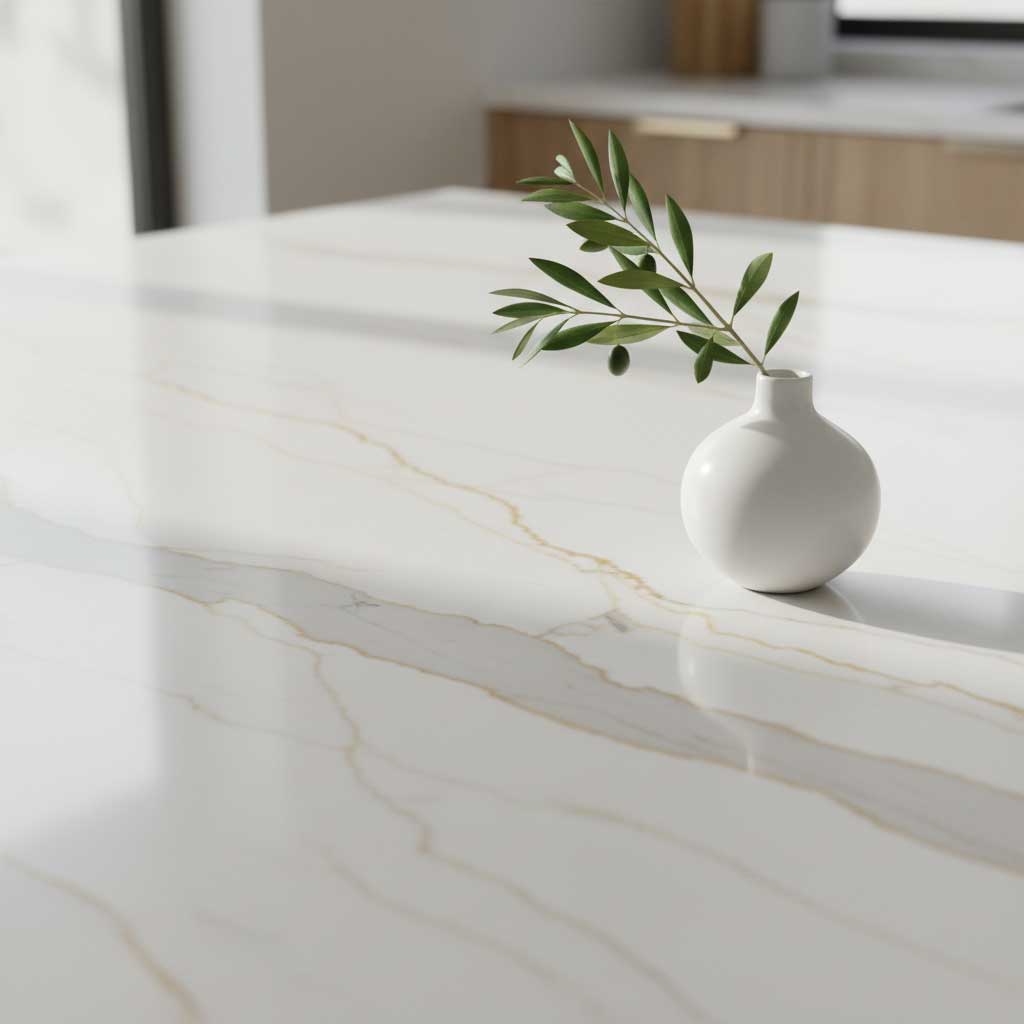
Warm Neutrals — 15–20 %
Warm neutrals have been the fastest-growing colour category since 2022, driven by the broader "warm minimalism" design movement that has gained enormous momentum on social media. Soft beige, cream, and greige (grey-beige hybrid) tones bring organic warmth to kitchen spaces and pair beautifully with the natural oak cabinetry, rattan accents, and warm metal hardware—brushed brass, satin gold—that currently dominate kitchen design boards on Pinterest and Instagram.
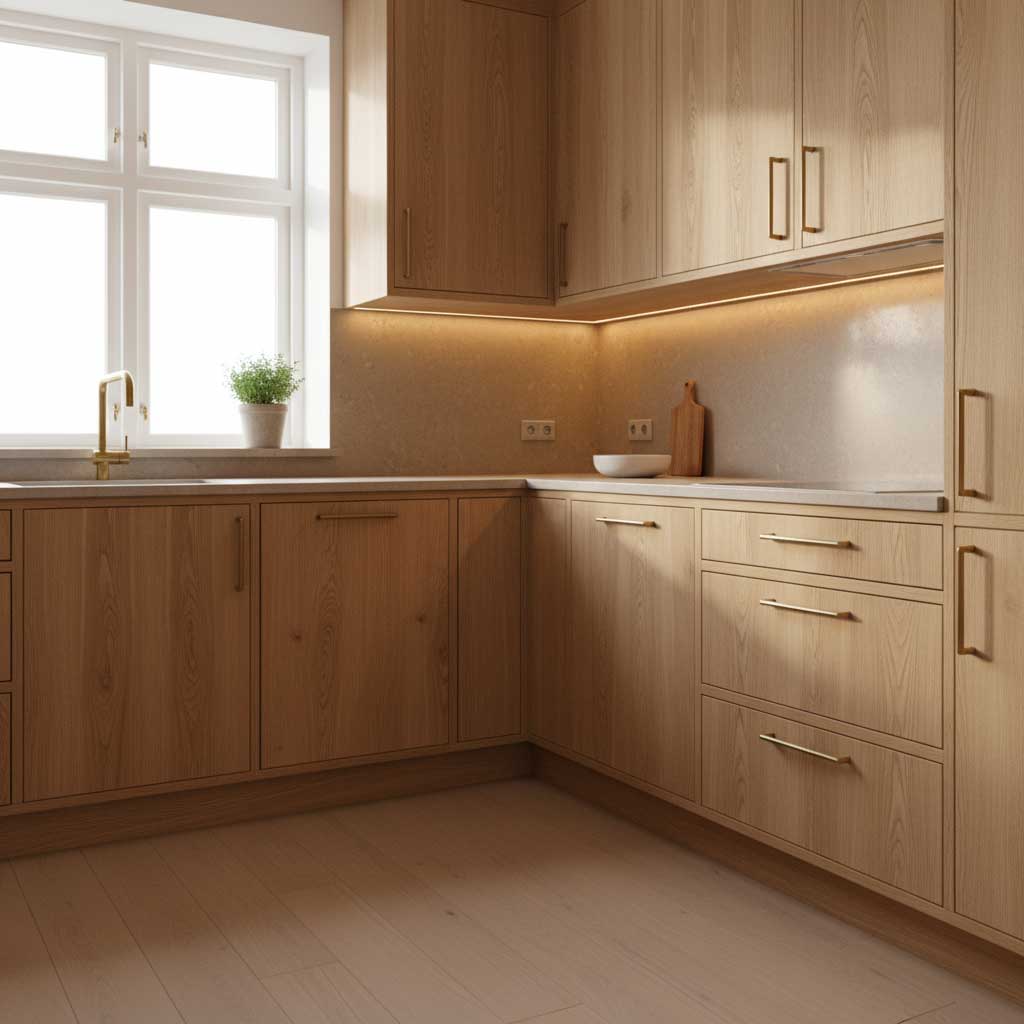
This category represents both opportunity and risk. The opportunity: growing demand with less competition than the saturated marble-look white segment. The risk: warm neutrals are more taste-specific. A white countertop works in virtually any kitchen; a warm greige requires complementary cabinetry and flooring. Stock these thoughtfully, know your target market's design sensibilities, and start with 2–3 versatile mid-tone options rather than committing deeply.
Concrete and Industrial Looks — 10–15 %
Concrete-look quartz in muted grey tones serves a distinct and loyal aesthetic niche. These designs feature uniform grey colouring with subtle tonal variation—no veining, but a nuanced surface character that convincingly evokes poured concrete. Nearly all are specified with a honed (matte) or leathered finish, as the reduced reflectivity reinforces the industrial aesthetic.
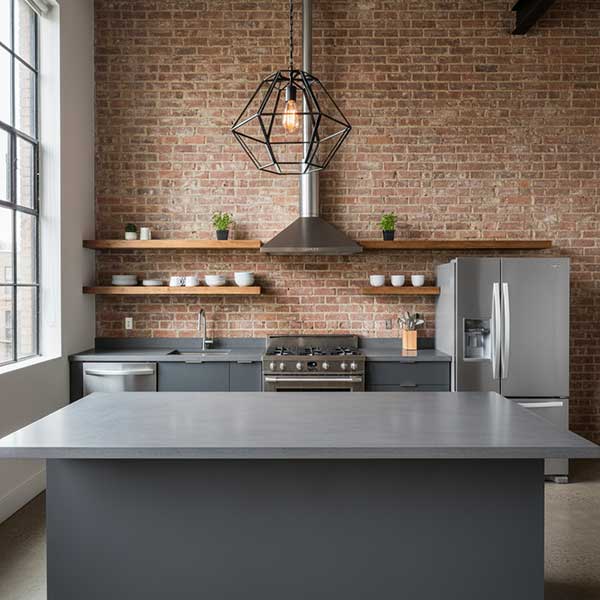
This category is popular in urban markets, loft conversions, and commercial food-service environments—coffee shops, casual restaurants, bar counters. Demand is steady rather than explosive, which makes it a reliable inventory item with lower markdown risk.
Bold Dramatic Veining — 5–10 %
Large-scale, high-contrast vein patterns—thick dark veins on white, gold veins sweeping across a grey field—represent the premium end of the colour spectrum. These are statement pieces, designed for showcase projects where the countertop is the dominant visual element in the room. They work best on oversized islands in open-plan living spaces, where the dramatic pattern has room to breathe.
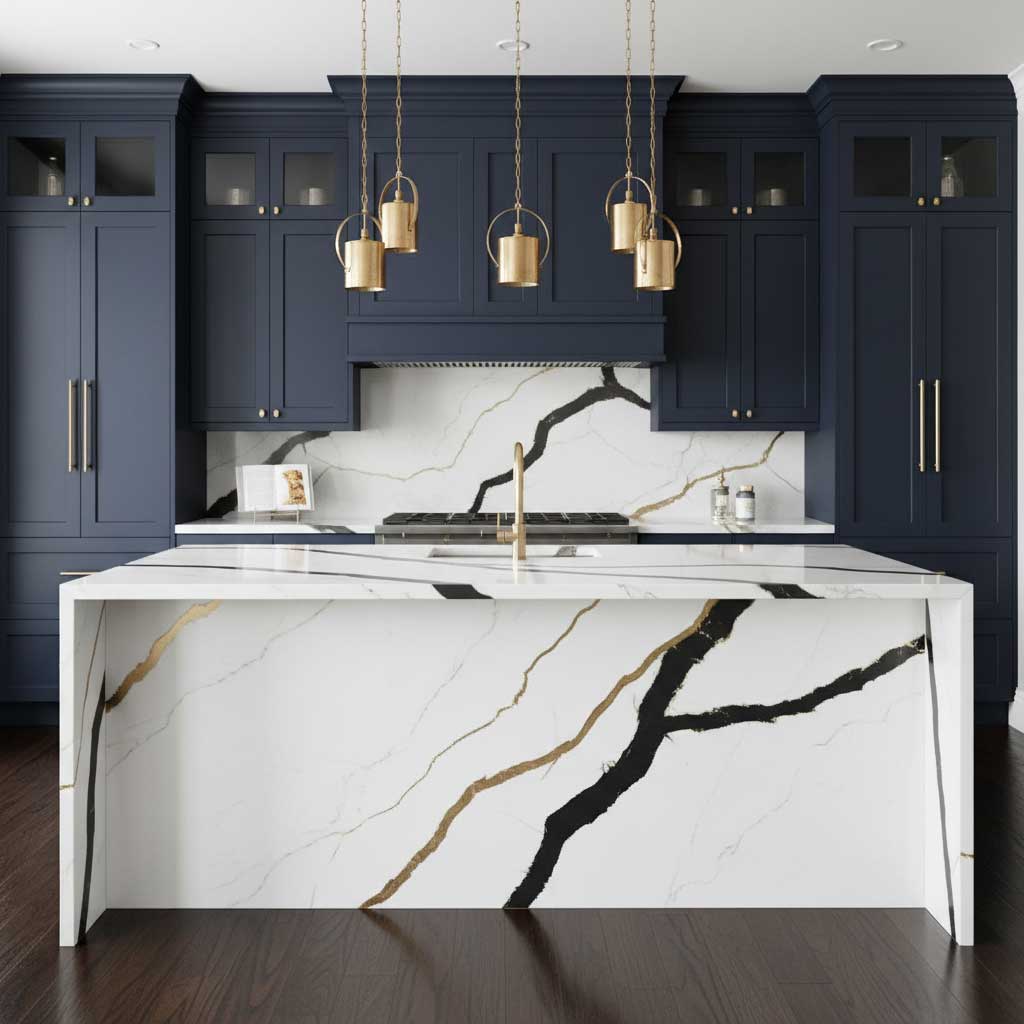
Because these designs are visually bold and polarising—people either love them or consider them excessive—they carry lower absolute demand but higher per-unit margins. They are a worthwhile addition to a well-rounded colour portfolio, particularly if your market includes luxury residential or high-end hospitality.
Regional Colour Preferences
If you are distributing into a specific geographic market, local colour preferences matter. North America favours marble-look whites overwhelmingly, with warm neutrals gaining fast and 30 mm thickness preferred. Europe leans toward cleaner whites and warm neutrals, with smaller vein patterns and 20 mm as standard. The Middle East favours bolder patterns, gold-toned accents, and high-gloss finishes. Southeast Asia and East Asia prefer lighter colours suited to typically smaller kitchen footprints, with 20 mm standard. Latin America gravitates toward warmer tones—Calacatta Gold and beige variants perform well.
6. Surface Finish Options
Surface finish affects both the appearance and the daily-use experience of a kitchen countertop, and it has practical maintenance implications that your downstream customers should understand.
Polished (High Gloss) — ~70–75 % of Installations
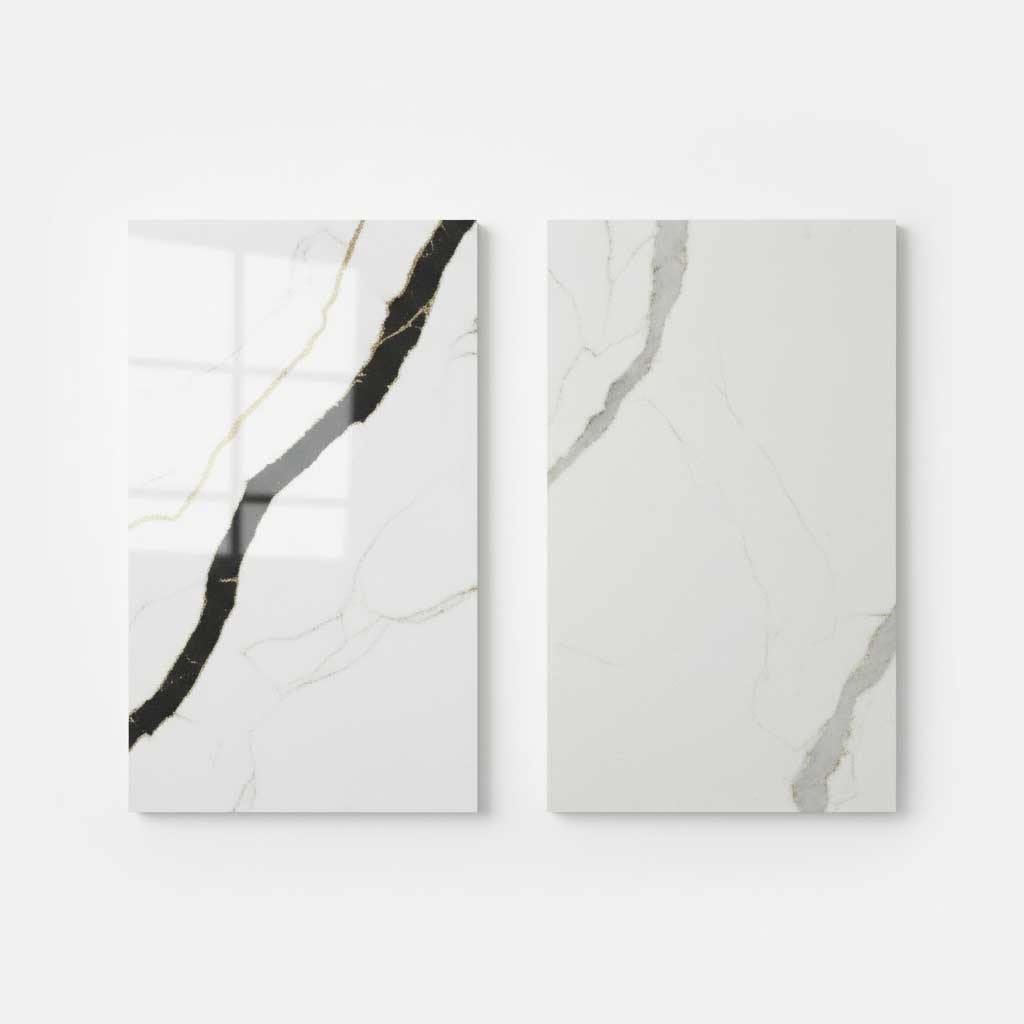
Polished quartz, measuring 85–95 GU (gloss units) on a standard 60-degree gloss meter, remains the dominant finish for kitchen countertops. The reflective surface enhances pattern depth—veining appears more vivid and three-dimensional, and the material reads more convincingly as natural stone. Polished surfaces are easy to wipe clean; spills are immediately visible, which actually helps prevent staining from prolonged contact.
The trade-off: polished surfaces show fingerprints, water spots, and smudges more readily, especially on dark colours. On marble-look whites, this is barely noticeable. On solid blacks or dark greys, it can be a genuine maintenance annoyance. Buyers stocking dark polished colours should be prepared to address this with end-user care guidance.
Honed (Matte) — ~20–25 %
Honed finishes (15–30 GU) have been steadily gaining share as the design world shifts toward softer, more tactile surfaces. The matte appearance reads as more organic and less "manufactured," which appeals to the current warm-minimalism aesthetic. Honed quartz also feels different to the touch—softer, almost velvety—which adds a sensory dimension that polished surfaces lack.
A common misconception is that honed surfaces stain more easily. The actual stain resistance of the material is identical to polished; the chemical composition and porosity are the same regardless of surface treatment. However, surface residues (dried water spots, fingerprints) can be slightly more visible on honed finishes because the matte surface does not reflect light to mask them.
Textured / Leathered — ~5 %
Textured finishes add a subtle surface relief that creates a tactile, organic feel. In kitchen applications, leathered finishes are most effective on dark-coloured quartz, where the texture breaks up the surface plane and dramatically reduces the visibility of fingerprints and water spots—addressing the primary practical objection to dark polished countertops. This finish is gaining traction in premium and commercial segments, though it remains niche in overall volume terms.
7. Kitchen Layout Planning and Material Yield
One of the skills that separates a good countertop distributor from an average one is the ability to accurately estimate material requirements from a kitchen floor plan. This saves your fabricator customers time, reduces over-ordering, and builds confidence in your technical knowledge.
Here is a practical reference for the most common kitchen layouts and their typical material consumption from standard 3200 × 1600 mm slabs:
| Kitchen Layout | Typical Countertop Length | Approx. Area | Slabs Required (3200×1600) | Estimated Yield |
|---|---|---|---|---|
| Galley (parallel runs) | 2 × 2400 mm | ~3.0 m² | 1 slab | ~80 % |
| L-Shaped | 3000 + 1800 mm | ~3.5 m² | 1 slab | ~75 % |
| U-Shaped | 3000 + 2400 + 1800 mm | ~5.0 m² | 1–2 slabs | ~70 % |
| L-Shaped + Island | L: 4800 mm + Island: 2400 mm | ~5.5 m² | 2 slabs | ~75 % |
| Large U + Island | U: 7200 mm + Island: 3000 mm | ~7.5 m² | 2–3 slabs | ~70 % |
These estimates assume a standard countertop depth of 600 mm and do not include waterfall panels, full-height backsplash material, or significant overhang extensions. Always add 10–15 % to your calculated area to account for cutting waste, fabrication errors, and edge profile material.
Experienced fabricators often "nest" cuts from multiple projects on a single slab to reduce waste. If you are supplying a fabrication shop that processes high volumes, encourage them to batch jobs using the same colour. A shop running three L-shaped kitchens in Calacatta Gold can often cut all three from two slabs rather than three, saving a full slab's worth of material cost.
8. Sink and Cooktop Cutout Considerations
Cutouts for sinks and cooktops are the most structurally sensitive points on any kitchen countertop. Improper cutout placement, insufficient material margins, or rough cutting technique are the leading causes of in-service cracking in quartz countertops. B2B buyers do not typically perform cutouts themselves, but understanding these requirements helps you specify products correctly and advise fabricator customers.
Undermount Sinks
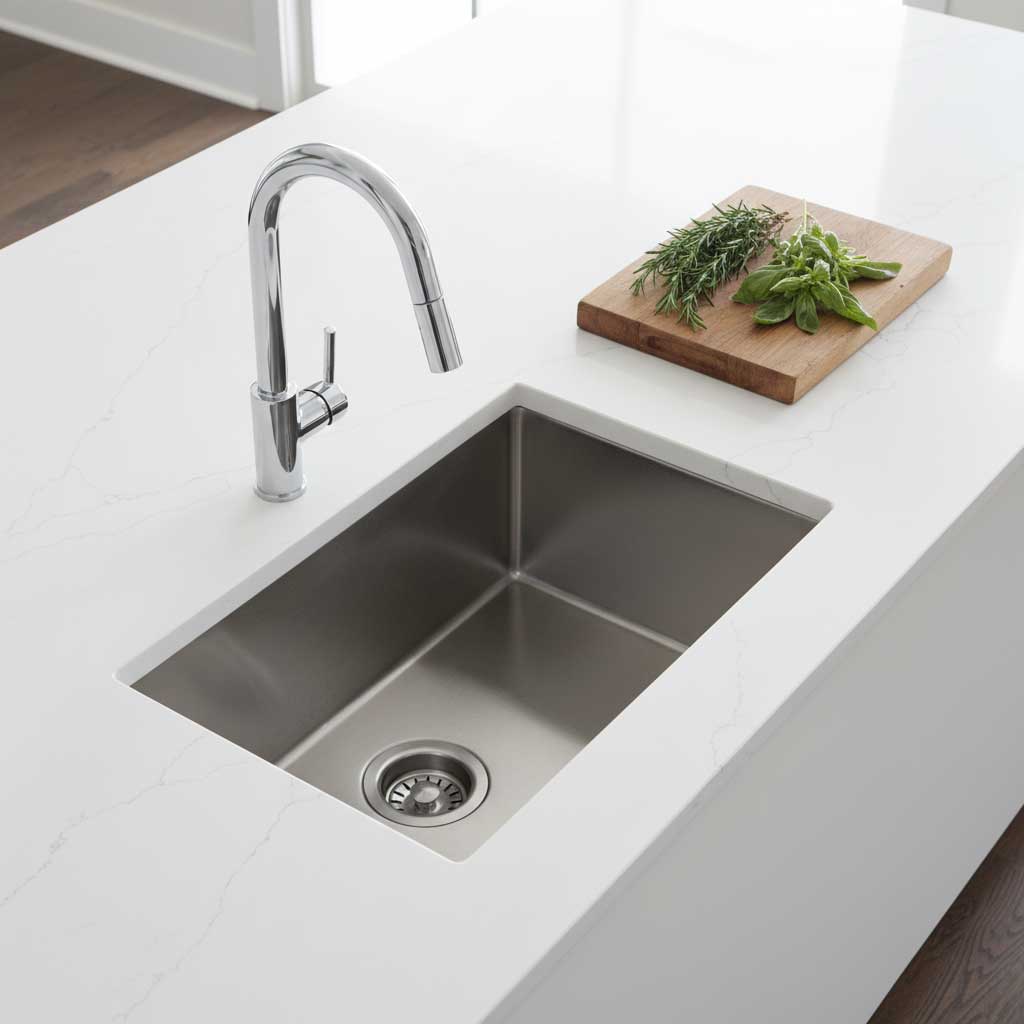
Undermount sinks are by far the most common sink type in quartz countertop installations, accounting for over 80 % of residential kitchen projects. The sink is mounted below the countertop, with the quartz surface cantilevering over the sink opening. This creates a clean, seamless look and makes it easy to wipe debris directly from the countertop into the sink.
The critical structural requirement is that the quartz must have adequate material around the cutout perimeter. The Natural Stone Institute recommends a minimum of 75 mm (3 inches) of material between the edge of the sink cutout and the front edge of the countertop. Many fabricators use 100 mm as their working minimum. The rear margin (between the cutout and the wall/backsplash) can be smaller—50 mm is typically acceptable—because this area is supported by the cabinet back rail.
Cooktop Cutouts
Cooktop (hob) cutouts follow similar principles but are often larger, which increases the stress concentration risk. A typical four-burner cooktop cutout measures approximately 560 × 490 mm, leaving relatively narrow material margins on a standard 600 mm-deep countertop. The minimum distance from the cooktop cutout edge to the nearest countertop edge should be at least 50 mm, and ideally 75 mm or more. The distance from the cooktop cutout to any sink cutout or seam should be at least 150 mm.
For cooktop installations, internal corner radii of the cutout are critical. Sharp internal corners concentrate stress and are a frequent cracking initiation point. All internal corners of cooktop cutouts should have a minimum radius of 10 mm (0.4 inches)—most fabricators use a standard 25 mm (1-inch) radius to provide an adequate safety margin.
Never position a seam within 150 mm of a cutout edge. Seams are inherently weaker than continuous material, and the combination of a seam near a cutout—particularly a cooktop cutout that is subject to thermal cycling—is the most common cause of catastrophic cracking in quartz kitchen countertops.
9. Installation Technical Requirements
While B2B buyers are not typically handling installation, a solid working knowledge of installation requirements is essential for providing accurate product specifications, avoiding warranty issues, and building credibility with your fabricator and contractor customers.
Support and Substrate Requirements
Quartz countertops in kitchen applications must be continuously supported along their length by the cabinet carcasses below. Standard base cabinets at 560–600 mm depth provide adequate support for both 20 mm and 30 mm quartz. Where cabinets are inset from the countertop edge (for example, to accommodate decorative mouldings or an integrated apron front), the unsupported span should not exceed 150 mm without supplementary support.
For dishwasher openings and other cabinet gaps, a supporting rail or strip of plywood should bridge the opening beneath the quartz to prevent localised flexing. This is standard fabrication practice but worth reinforcing with your customers—missed support at a dishwasher opening is a common source of hairline cracks.
Overhang Limits
Unsupported overhangs, such as breakfast bar extensions beyond the cabinet line, must respect the structural limits of the material. For 20 mm quartz, maximum unsupported overhang should not exceed 300 mm (12 inches). For 30 mm, the limit extends to roughly 400–450 mm (16–18 inches). Beyond these distances, concealed steel brackets, support legs, or corbels must be installed at intervals of no more than 600 mm to distribute the load.
Overhangs intended for bar seating—where people will lean on the countertop or rest elbows—should always be reinforced with brackets regardless of overhang distance, because the dynamic loading from human weight is significantly greater than static load.
Seam Placement Strategy
For kitchen countertops longer than the maximum slab dimension (typically 3200 mm), seams are unavoidable. Thoughtful seam placement is important for both structural integrity and visual acceptability.
Position seams at natural transition points wherever possible—at the inside corner of an L-shaped layout is the classic location, as the angle change disguises the joint. On straight runs, centre the seam as close to the middle of the span as practical, away from high-use areas like the sink zone or the primary food-preparation zone. Maintain a minimum distance of 150 mm between any seam and any cutout (sink, cooktop, or other). And always use colour-matched, high-quality epoxy adhesive for seam bonding.
For marble-look quartz with directional veining, seam alignment requires planning before the slab is cut. The fabricator needs to map the vein pattern and determine how to orient adjacent pieces so that the veining flows naturally across the joint. This planning step adds time to the fabrication process but dramatically improves the finished result. Poorly aligned veins at a seam are one of the most common end-user complaints in quartz countertop installations.
Expansion Gaps and Silicone Joints
Quartz has a relatively low coefficient of thermal expansion, but it is not zero. In kitchen applications, the countertop is typically restrained by cabinets and backsplash on three sides, so thermal movement is minimal. However, where the countertop abuts a wall, a 3–5 mm expansion gap should be maintained and filled with colour-matched silicone sealant. This prevents stress buildup if the countertop expands or shifts slightly and avoids hard contact with the wall structure that could cause edge chipping.
10. Performance Standards and Certifications
For B2B buyers importing quartz into regulated markets or supplying to projects with formal performance specifications, knowing the relevant testing standards is not optional—it is a competitive requirement. Your ability to provide certified test data differentiates you from suppliers who cannot, and it opens access to specification-driven commercial and institutional projects where test compliance is a mandatory submission requirement.
EN 14617 — European Standard for Agglomerated Stone
The EN 14617 series is the primary European standard governing the physical properties of engineered stone products. It covers a comprehensive range of characteristics including flexural strength (EN 14617-2), water absorption (EN 14617-1), abrasion resistance (EN 14617-4), dimensional stability under thermal cycling (EN 14617-12), and chemical resistance. If you are selling into EU markets or into projects specifying European standards, your manufacturer's products should be tested and certified to the relevant EN 14617 sub-parts.
Reputable Chinese quartz factories will have EN 14617 test reports available from accredited third-party testing laboratories (such as SGS, TÜV, or Bureau Veritas). Request these reports during supplier qualification and verify that the tested product matches what you are ordering—not a different formulation or colour.
ASTM C1722 — American Standard for Quartz Surfaces
The ASTM C1722 standard (Standard Specification for Quartz Surface Products) establishes minimum performance thresholds for quartz countertop material in the North American market. Key requirements include minimum flexural strength of 20 MPa, maximum water absorption of 0.05 %, and specified limits for abrasion resistance and dimensional stability. Compliance with ASTM C1722 is widely accepted by North American architects, designers, and specifiers as evidence of product quality.
NSF/ANSI 51 — Food Contact Certification
If your customers include commercial kitchen outfitters, restaurant chains, or institutional food-service operators, NSF International certification to NSF/ANSI 51 (Food Equipment Materials) is a significant selling point. This certification confirms that the quartz surface is safe for direct food contact and meets specific requirements for cleanability, material composition, and absence of harmful leachable substances.
GREENGUARD Gold — Indoor Air Quality
GREENGUARD Gold certification (administered by UL) verifies that a product meets stringent limits for VOC (volatile organic compound) emissions into indoor air. This certification is increasingly specified for healthcare facilities, schools, and projects pursuing green building certifications such as LEED, WELL, or BREEAM. For B2B buyers targeting institutional or sustainability-focused markets, GREENGUARD Gold can be a decisive differentiator.
| Property | Test Standard | Typical Result for Quality Quartz | Minimum Requirement |
|---|---|---|---|
| Flexural Strength | EN 14617-2 / ASTM C1722 | 45–65 MPa | ≥ 20 MPa (ASTM) / ≥ 30 MPa (typical spec) |
| Water Absorption | EN 14617-1 / ASTM C1722 | 0.01–0.03 % | ≤ 0.05 % (ASTM) |
| Mohs Hardness | EN 101 | 6.5–7 | ≥ 6 |
| Density | EN 14617-1 | 2.3–2.5 g/cm³ | ≥ 2.2 g/cm³ |
| Abrasion Resistance | EN 14617-4 | Volume loss ≤ 175 mm³ | ≤ 250 mm³ |
| Thermal Shock Resistance | EN 14617-6 | No cracking after 20 cycles | No visible damage |
| Chemical Resistance | EN 14617-10 | Class C4 (resistant to household chemicals) | ≥ C3 |
When evaluating a new quartz manufacturer, request third-party test reports (not factory self-test certificates) for EN 14617 and/or ASTM C1722. Verify that the testing laboratory is accredited (ISO 17025) and that the sample tested corresponds to the specific product series you intend to purchase. Some factories test only their best-performing formulation and present the results as representative of their entire product range—this is misleading.
11. Wholesale Sourcing Strategy for Kitchen Quartz
Sourcing quartz countertop material from China is a well-established practice—China accounts for over 60 % of global quartz surface production—but doing it well requires more than finding the lowest price on Alibaba. The difference between a successful sourcing operation and a costly mistake often comes down to how systematically you approach colour selection, quality verification, supplier relationship management, and pricing negotiation.
Colour Portfolio Strategy
Rather than attempting to stock every available colour (some factories offer 200+ options), build a focused portfolio of 15–25 core colours that covers the major demand categories discussed in Section 5 above. A well-balanced starting inventory might be structured roughly as follows: 8–10 marble-look whites ranging from subtle Carrara to dramatic Calacatta, 3–4 warm neutrals including at least one greige and one cream tone, 2–3 concrete/grey designs in honed finish, 2–3 solid colours (pure white, mid-grey, black), and 1–2 bold or dramatic options for the premium segment. This range provides broad market coverage while keeping inventory manageable and minimising the risk of slow-moving colours tying up working capital.
Resist the temptation to stock colours based solely on factory catalogue images. Colour photography under factory lighting, compressed to JPEG and viewed on your laptop screen, is a poor representation of how the material will look in a showroom or installed kitchen. Always request physical samples and evaluate them in natural daylight and under the artificial lighting conditions your market's kitchens typically use (LED warm white, for example). The cost of a sample set is negligible compared to the cost of importing a container of material that looks different from what you expected.
Quality Verification Before Ordering
Before committing to a production order—especially with a new supplier or for a new colour—conduct thorough quality checks on delivered samples. Key inspection points include colour accuracy versus the approved sample (evaluate under at least three lighting conditions: daylight, warm LED, and cool fluorescent), gloss level consistency (measure with a 60-degree gloss meter at five or more points across the slab face), thickness uniformity (measure at four corners and centre; variation should not exceed ±0.5 mm), surface flatness (lay a straight edge across the slab and check for warping or bowing), and edge quality (inspect for chips, rough spots, or inconsistent profiles along factory-finished edges).
If your order volume justifies it, consider commissioning third-party pre-shipment inspection (PSI) through agencies such as SGS, Bureau Veritas, or AsiaInspection. A PSI typically costs USD 250–400 per inspection and provides independent verification of quantity, quality, packaging, and loading conditions before the container is sealed. For first-time orders with a new supplier, this is inexpensive insurance against a costly disappointment.
Volume Pricing and Negotiation
Pricing from Chinese quartz manufacturers is highly volume-sensitive. Here is a general reference for how pricing typically scales:
| Order Volume | Typical Discount vs Base Price | Recommended For |
|---|---|---|
| Trial order (1 container, mixed colours) | Base price / no discount | New buyers testing supplier quality |
| Regular orders (2–5 containers/month) | 5–10 % off base | Established importers and regional distributors |
| Volume orders (5–10 containers/month) | 10–20 % off base | Large distributors, project-based procurement |
| Annual contracts (committed monthly volume) | 15–25 % off base | Major distributors with predictable demand |
For mixed-colour containers—which are standard for initial inventory builds—negotiate a blended rate based on total container volume rather than per-colour pricing. Some factories price popular colours lower (because they produce them in high volume with optimised efficiency) and niche colours higher. Understanding this pricing structure lets you optimise your colour mix to achieve the best blended cost per square metre.
Building a consistent ordering cadence with a single preferred manufacturer almost always yields better long-term value than shopping every order across multiple factories. Factories prioritise reliable repeat customers for production scheduling, quality attention, and pricing flexibility. When problems arise—and they will eventually, in any manufacturing relationship—a factory that values your ongoing business is far more responsive to resolving issues than one that sees you as a one-time transactional buyer.
Supplier Evaluation Beyond Price
Price per square metre is the most visible number in any quotation, but it is not the only number that matters. Evaluate potential suppliers on the total cost of doing business, which includes material price, packaging quality (poor packaging leads to breakage and claims), loading quality (proper container loading prevents transit damage), production consistency (colour and thickness variation between batches), communication responsiveness, and willingness to resolve quality issues when they occur.
Visit the factory if at all possible. A half-day factory visit tells you more about a supplier's real capability than months of email exchanges. Look at the press equipment (is it modern Breton or equivalent, or older, less precise machinery?), the curing ovens, the polishing lines, and the quality control station. Look at how slabs are stored and handled. Look at the packaging line. These observations are difficult to fake and give you genuine insight into whether the factory can deliver the quality and consistency your market requires.
If you are building or expanding a quartz countertop distribution business, our team can provide detailed product specifications, physical samples, and CIF pricing for your target port within 12–24 hours. We supply over 200 colours and patterns, including the full range of marble-look, warm neutral, concrete, and solid options discussed in this guide—you can browse the full catalogue at QuartzCrafts Products. Contact us with your target colour range, estimated monthly volume, and destination port to receive a customised quotation.
12. Logistics and Container Loading Optimisation
Getting quartz from a factory in Guangdong or Fujian province to a warehouse in Houston, Hamburg, or Dubai involves a chain of logistics decisions that directly impact your landed cost and the condition of the product on arrival. Understanding the basics of container loading, packaging, and shipping terms will help you avoid costly mistakes and negotiate more effectively with both your manufacturer and your freight forwarder.
Container Types and Capacity
Quartz slabs are almost always shipped in standard dry containers—20-foot (20GP) or 40-foot (40GP/40HQ). The limiting factor for loading is almost always weight rather than volume, because quartz is a dense material (approximately 48 kg/m² at 20 mm thickness and 72 kg/m² at 30 mm thickness). A 20GP container has a maximum payload of approximately 22,000 kg and a 40GP approximately 26,000 kg (though weight limits vary by shipping line and route).
| Container | 20 mm Slabs (3200×1600) | 30 mm Slabs (3200×1600) | Approx. Area |
|---|---|---|---|
| 20GP | ~30–50 slabs | ~20–35 slabs | ~150–260 m² |
| 40GP | ~55–85 slabs | ~40–60 slabs | ~280–440 m² |
| 40HQ | ~60–90 slabs | ~45–65 slabs | ~310–460 m² |
These ranges are approximate because the exact number depends on the packaging method (A-frame, flat stacking, or bundle packing), the amount of timber and foam used for protection, and the specific weight limit applied to your shipment by the carrier.
Packaging Methods
Packaging quality is one of the most underappreciated factors in quartz importation. A slab that survives pressing, polishing, and quality control can still arrive cracked or chipped if the packaging fails to protect it through 3–5 weeks of ocean transit, crane handling at port, and overland trucking on potentially rough roads.
The standard packaging method uses wooden bundles (A-frame or flat crate) with individual slabs separated by foam sheets or plastic interleaving. The bundle is banded with steel or plastic strapping and secured to the container floor with blocking and bracing. Premium packaging may include additional edge protection (foam corner guards or plastic edge strips) and thicker plywood crating.
Always specify your packaging requirements in the purchase contract, and if possible, request photographs of the packed container before it is sealed. Breakage claims are time-consuming, stressful, and often only partially recoverable from insurance. Prevention through proper packaging is far more cost-effective.
Incoterms and Pricing Basis
Most Chinese quartz manufacturers quote on FOB (Free on Board) or CIF (Cost, Insurance, and Freight) basis. For buyers new to importing, CIF is often simpler because the manufacturer arranges and pays for ocean freight and basic insurance—you receive a single all-in price to your destination port. As you gain experience and volume, switching to FOB and arranging your own freight and insurance through a preferred freight forwarder can yield cost savings of 5–15 % on the logistics component, because you negotiate shipping rates based on your total freight volume rather than relying on the factory's arrangements.

Transit Time and Lead Time Planning
Total lead time from order placement to container arrival at your port typically ranges from 5–8 weeks, broken down roughly as follows: production time 2–4 weeks (depending on colour, volume, and factory schedule), packaging and loading 2–3 days, ocean transit 2–4 weeks (depending on destination—Southeast Asia is faster, South America or Africa is slower), and customs clearance 2–5 days. Plan your inventory accordingly, and place orders well in advance of anticipated demand peaks. Running out of a popular colour during a busy season is a missed revenue opportunity that proper planning can prevent.
Rather than placing one large order per quarter, consider placing smaller monthly orders. This reduces your capital commitment at any given time, keeps your inventory fresher, and gives you flexibility to adjust colour ratios based on real-time demand. Many factories offer the same volume pricing for committed monthly orders as they do for single large orders—ask for a monthly supply agreement rather than a per-shipment quotation.
Sourcing quartz kitchen countertops from China is a proven, well-established supply chain that thousands of distributors worldwide rely on daily. The keys to success are straightforward: choose the right colours for your market, verify quality rigorously before committing, build a genuine relationship with a capable manufacturer, and manage your logistics professionally. Get these fundamentals right, and the commercial opportunity is substantial.