Our Biggest Single Shipment to the GCC This Quarter
In the first week of February 2026, we completed loading and dispatched 20 full 40-foot containers of engineered quartz stone slabs from our Guangdong factory — all bound for Dammam port in the Eastern Province of Saudi Arabia. It was our largest single GCC-bound order in Q1 2026, and one of the largest individual project shipments we’ve handled in recent memory. The slabs are destined for a luxury hospitality development in Riyadh: a 5-star hotel and serviced apartment complex that specified premium Calacatta and Statuario-style quartz for lobbies, 600+ bathroom vanity tops, restaurant countertops, and elevator wall cladding.
We wanted to take you behind the scenes on this order — not just because it’s a milestone for us, but because it illustrates the level of coordination, quality control, and logistical planning that goes into fulfilling a large-scale B2B quartz stone project. Whether you’re a distributor who’s considering a large project order or a contractor evaluating Chinese quartz suppliers, here’s what the process actually looks like from the inside.
The Order Scope: What 20 Containers Actually Looks Like
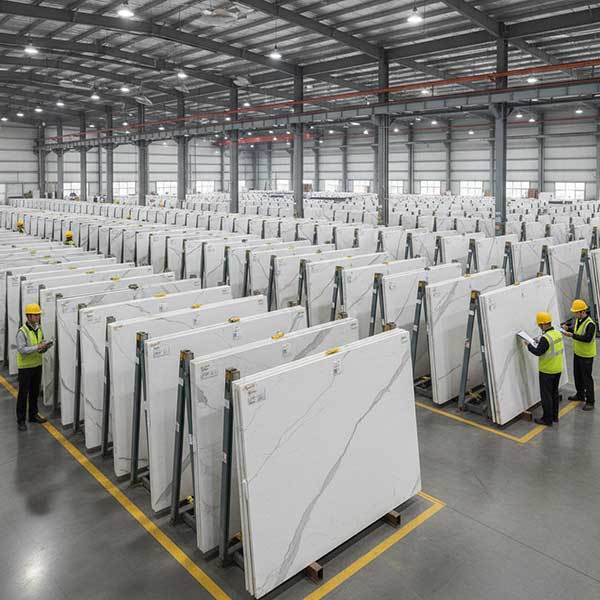
To put this in perspective, each 40-foot container holds approximately 80–100 engineered quartz slabs depending on the thickness and slab dimensions. For this order, the breakdown was roughly as follows: 12 containers of Calacatta Gold quartz in 3050×1440×20mm (polished finish), 5 containers of Statuario White quartz in the same dimensions, and 3 containers of custom-cut Calacatta pieces pre-sized for vanity top applications at 1500×550×20mm. In total, we shipped approximately 1,600 full-size slabs and over 2,000 pre-cut vanity top pieces. The combined surface area exceeded 8,000 square meters.
The customer — a Saudi-based general contractor working on behalf of a well-known international hotel group — had very specific requirements. Every slab needed to come from production batches with matching vein patterns and consistent color tone, because the end-use environments would have large, visible quartz surfaces placed side by side. This is one of the most common and important requirements in hospitality projects, and it’s something that separates experienced quartz manufacturers from those who treat every order as a one-off.
Production Planning: Ensuring Batch Consistency Across 20 Containers
When we received the confirmed purchase order in late November 2025, our production planning team immediately allocated dedicated press line runs for this project. Rather than pulling from general inventory, we scheduled a continuous production block — running the same quartz recipe, the same resin batch, and the same vein pattern programming across all 1,600+ slabs. This is critical for color and pattern consistency.
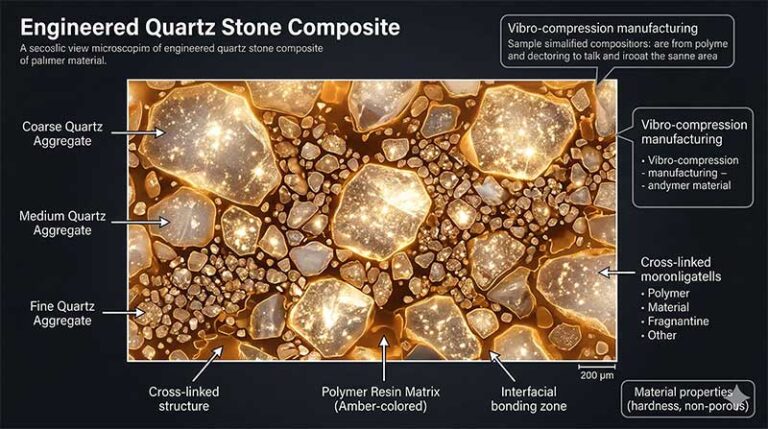
Engineered quartz is manufactured by combining roughly 93% crushed natural quartz aggregate with 7% polyester resin and pigments, then pressing and curing the mixture into slabs. Even small variations in aggregate particle size, resin ratio, or pigment concentration can create visible differences between batches. For a project like this, where hundreds of slabs would be installed in the same building — some literally side by side — batch consistency isn’t optional. It’s the whole point. For projects involving food-contact applications such as restaurant countertops, compliance with internationally recognized standards such as NSF/ANSI 51 – Food Equipment Materials is also critical to ensure the material is safe and suitable for commercial hospitality environments.
Our production team ran this order across a 23-day production window, operating two shifts per day. Each day’s output was tagged with production batch codes and photographed for traceability. By the time production was complete, we had generated over 3,200 slab-specific quality records.
Quality Control: What We Check and Why It Matters

Our quality control process for this shipment followed our standard Grade A export protocol, which involves inspection at four stages: post-press, post-calibration, post-polish, and pre-packing. At each stage, inspectors check for specific defect types.
Post-Press Inspection
Immediately after curing, slabs are visually inspected for structural defects — air pockets, cracks, delamination, or uneven density. Any slab that shows structural issues at this stage is rejected outright. For this order, our rejection rate at post-press was approximately 2.1%, which is within our normal range.
Post-Calibration and Post-Polish Inspection
After calibration (grinding to precise thickness) and polishing, we inspect for surface quality: scratch marks, uneven gloss, color inconsistency, and vein pattern accuracy. We use both visual inspection under high-intensity lights and digital color measurement tools to ensure ΔE (color difference) values stay below 1.5 across the batch. For this Saudi order, the average ΔE across all accepted slabs was 0.8 — well within spec.
Pre-Packing Final Inspection
Before any slab gets packed, it goes through one final visual check. Inspectors look for edge chips, surface scratches that might have occurred during handling, and dimensional accuracy. Slabs that pass all four inspection stages receive a Grade A sticker with a unique serial number and batch code. For this shipment, the overall pass rate through all four stages was 96.4% — the rejected slabs were recycled back into aggregate feedstock.
Packing and Loading: Protecting 8,000+ m² of Quartz in Transit
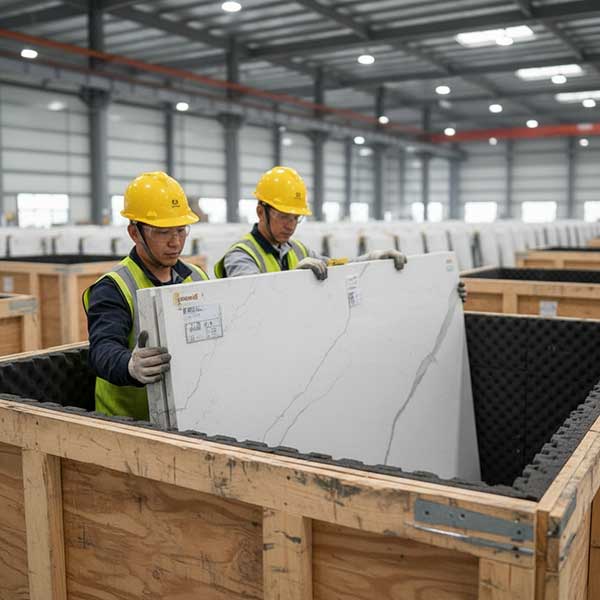
Packing stone slabs for ocean freight is something that sounds straightforward but is actually one of the most critical parts of the export process. A single broken slab in transit isn’t just a material loss — it can cascade into project delays, re-order costs, and damaged client relationships. For this 20-container shipment, our packing team followed our standard A-frame wooden crate protocol with a few additional reinforcement measures given the order’s importance.
Each full-size slab was individually wrapped in protective PE foam sheeting, then placed vertically into fumigated wooden crates. Crates were built with internal dividers between every slab to prevent direct contact. Corner reinforcements and anti-tip bracing were added to each crate. For the pre-cut vanity tops, which are more fragile due to their smaller dimensions and the presence of cutout features, we used individual foam-lined cardboard boxes nested inside larger wooden crates.
Loading 20 containers took three full days. Each container was loaded using forklifts with specialized stone clamps, and the crates were secured inside the containers with ratchet straps and wooden blocking to prevent any shifting during the roughly 18-day ocean transit from Nansha port (Guangzhou) to Dammam.
Logistics Coordination: From Factory Gate to Dammam Port

For a 20-container shipment, logistics coordination is a project in itself. Our export logistics team worked with our freight forwarding partner to book container space on a direct service from Nansha to Dammam — routing via Singapore — with an estimated transit time of 18 days. We coordinated the container delivery schedule with the shipping line to ensure all 20 containers were available at our factory on the correct loading dates, and we staggered the loading across three days to match our quality control and packing throughput.
Documentation for this shipment included commercial invoices, packing lists, certificates of origin, fumigation certificates for the wooden crates (ISPM-15 compliance), NSF/ANSI 51 certification copies for the food-contact surfaces, and test reports for the specific quartz compositions shipped. Saudi Arabian customs authorities are thorough, and incomplete documentation can mean costly delays at Dammam port. We prepared all documents in advance and shared them digitally with the customer’s clearing agent two weeks before vessel arrival.
CIF Pricing and Payment Terms
This order was negotiated on CIF Dammam terms, meaning our responsibility included freight and insurance up to the destination port. For large project orders like this, we typically work with 30% deposit upon order confirmation, 70% balance against copy of the bill of lading. This payment structure balances our production cost coverage with the buyer’s need for assurance that goods have actually shipped before releasing the majority of funds. It’s a structure that works well for both sides when there’s established trust.
What This Order Tells Us About the Market
This 20-container shipment is a microcosm of broader trends we’re seeing in the Saudi and GCC quartz stone market. The order was large, highly specified, quality-conscious, and time-sensitive. The customer knew exactly what they wanted — down to the vein pattern style and gloss level — and they needed a supplier who could deliver batch consistency at scale. That combination of volume, specificity, and quality standards is becoming the norm for GCC project orders, not the exception.
For us, fulfilling this order smoothly reinforces something we’ve always believed: in the B2B quartz stone export business, the value isn’t just in the product. It’s in the production planning, the quality control rigor, the packing expertise, and the logistics coordination that ensures thousands of square meters of stone arrive on the other side of the world in perfect condition and on schedule. That’s what separates a transaction from a partnership.
If you’re planning a large project order and want to understand what’s involved from the supplier side, feel free to reach out. We’re always happy to walk you through the process and discuss how we can support your specific requirements.