Freight Costs Are Climbing Again — And Quartz Importers Need to Pay Attention
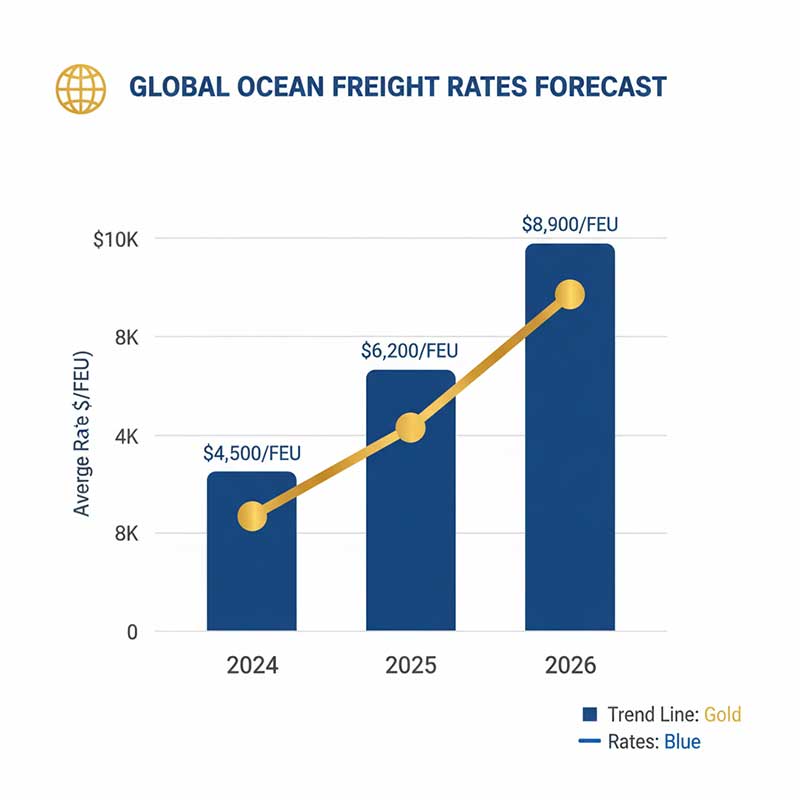
If you import engineered quartz stone from China, you’ve probably been watching ocean freight rates with a mix of frustration and resignation over the past couple of years. After the extreme volatility of 2021–2022, when container rates spiked to five or six times their pre-pandemic levels, the market corrected sharply through 2023 and into early 2024. According to the Drewry World Container Index, global container rates fell substantially from their 2021 peaks before stabilizing. For a while, rates looked almost normal again. But starting in mid-2024 and accelerating into 2026, rates have been on the rise once more — not to the crisis levels of the pandemic era, but enough to meaningfully impact the landed cost of heavy, high-volume products like quartz stone slabs.
For our customers — distributors, fabricators, and project contractors importing quartz from China to destinations across the Middle East, South America, North America, and Europe — understanding these freight dynamics isn’t optional. Shipping costs are a significant line item in any quartz stone CIF price, and even modest rate increases can erode margins or change the competitive calculus of a project bid. In this article, we’ll unpack what’s driving the current rate environment, quantify the real-world impact on quartz stone pricing, and share strategies that our most cost-savvy customers are using to manage freight exposure.
What’s Driving Freight Rate Increases in 2026
Several converging factors are pushing container shipping rates higher. Understanding them helps in forecasting whether rates are likely to stay elevated or if relief is on the horizon.
Red Sea Disruptions Continue
The Houthi attacks on commercial shipping in the Red Sea that began in late 2023 have continued intermittently into 2026. Major carriers and industry bodies such as BIMCO have reported widespread rerouting of vessels around the Cape of Good Hope instead of transiting the Suez Canal. This diversion adds roughly 10–14 days to transit times and significantly increases fuel consumption. The Suez Canal Authority has also reported reduced traffic volumes during peak disruption periods. For quartz stone shipments from China to ports in the Middle East, the disruption is less direct — most China-to-Gulf services don’t transit the Red Sea — but the cascading effect on global vessel schedules and container availability still pushes rates up across all routes.
Strong Global Demand and Capacity Constraints
Global trade volumes have recovered robustly. According to data from UNCTAD and the World Trade Organization (WTO), merchandise trade growth rebounded through 2024–2025, supported by infrastructure investment and construction activity in emerging markets. Meanwhile, although new container vessels are being delivered, effective capacity remains constrained due to longer voyage times and port congestion in certain regions. The result is a supply-demand imbalance that gives shipping lines pricing power.
Fuel Costs and Environmental Surcharges
Marine fuel (bunker) costs have risen modestly in 2025–2026, driven by higher crude oil prices and the phased implementation of environmental regulations under the International Maritime Organization (IMO), including decarbonization targets and carbon intensity requirements. Shipping lines are also introducing green surcharges to fund their transition to lower-emission fuels and vessels. While each individual surcharge may seem small, collectively they contribute meaningfully to higher all-in freight costs.
Real-World Impact: How Much More Are You Actually Paying?
Let’s put some numbers on this. The figures below are based on spot and short-term contract rates that our logistics team has been tracking for key quartz stone trade lanes, aligned with broader market benchmarks such as the Freightos Baltic Index (FBX). These are indicative ranges for a 40-foot container as of February 2026, compared to roughly the same period a year earlier.
China to Jebel Ali (Dubai), UAE
Current rate range: approximately $1,800–2,200 per 40ft container. Year-ago range: approximately $1,400–1,700. That’s an increase of roughly 25–30%. For a container carrying approximately 90 slabs of 20mm quartz at 3050×1440mm, the per-slab freight cost increase is about $4–6. On a CIF price of, say, $85–95 per square meter, the freight increase adds roughly $1.00–1.50 per square meter. Not catastrophic, but not negligible either — especially on high-volume project orders where it aggregates quickly.
China to Santos (São Paulo), Brazil
Current rate range: approximately $3,800–4,500 per 40ft container. Year-ago range: approximately $2,800–3,400. This trade lane has been significantly influenced by vessel redeployments and longer sailing routes caused by Red Sea rerouting. The $1,000+ per container increase translates to approximately $2.50–3.00 per square meter of quartz stone. For Brazilian importers already dealing with import duties and ICMS taxes, this additional freight cost further squeezes margins.
China to US East Coast (New York/Savannah)
Current rate range: approximately $4,200–5,000 per 40ft container. Year-ago range: approximately $3,200–3,800. The US trade lane remains highly competitive, but rates have still risen in line with global benchmarks tracked by Drewry and Freightos. The per-square-meter impact is approximately $2.00–2.80, depending on loading configuration and contract structure.
Strategies to Manage Freight Cost Exposure

Based on our conversations with customers and our own experience shipping hundreds of containers per year, here are the most effective strategies for managing freight costs in the current environment.
Consolidate Orders for Better Container Utilization
This sounds basic, but it’s the single most impactful lever. Shipping a full 40-foot container costs almost the same whether it’s 60% full or 100% full. Every slab you add to a container that has unused space reduces your per-square-meter freight cost. If your order volume doesn’t fill complete containers, talk to your supplier about consolidation with other orders headed to the same destination port to achieve full-container economics.
Consider FOB Instead of CIF — If You Have a Freight Forwarder You Trust
Many quartz stone importers default to CIF pricing because it’s simpler — the supplier handles everything. But in a rising freight market, CIF prices from any supplier will reflect higher shipping costs. If you have a freight forwarding partner who can negotiate competitive rates — particularly if they aggregate freight across multiple commodities — you may achieve a lower total landed cost by buying FOB and managing the freight yourself. This approach requires experience and reliable logistics partners but can offer greater control over costs.
Lock in Rates with Short-Term Contracts
Spot rates fluctuate week to week. If you have predictable order volumes, ask your freight forwarder or carrier about short-term (3–6 month) rate contracts. These typically offer more stability compared to pure spot exposure. Many global carriers now provide contract products indexed against recognized benchmarks such as the Drewry WCI or FBX, offering a balance between flexibility and protection against upward spikes.
Optimize Slab Thickness for Lighter Container Loading
A container of 20mm quartz slabs weighs significantly more than a container of 15mm slabs in the same dimensions. Since heavy cargo may trigger weight-related constraints or surcharges depending on route and carrier policies, switching to 15mm thickness where the application allows it — such as wall cladding, backsplashes, or non-structural vanity installations — can improve loading efficiency and potentially reduce freight exposure.
Plan Ahead and Pre-Book Production Slots
When orders are rushed, you lose flexibility to wait for favorable vessel schedules or consolidate cargo. Pre-booking production 4–6 weeks before the desired ship date allows better coordination with sailing schedules and reduces the risk of premium freight charges. In a volatile market, timing and predictability are powerful cost-control tools.
Our Outlook for the Second Half of 2026
Based on current trade forecasts from organizations such as UNCTAD and the WTO, and given ongoing geopolitical uncertainties affecting key shipping corridors, freight rates are likely to remain elevated through at least mid-2026. A significant correction may depend on further vessel capacity delivery and normalization of Red Sea transit routes.
For our customers, our advice is straightforward: don’t rely on freight rates falling in the short term. Instead, focus on controllable factors — order consolidation, loading optimization, contract strategy, and early planning — to protect margins. As always, our logistics and sales teams are available to discuss specific trade lanes and run CIF versus FOB comparisons tailored to your order volume and destination.
Just reach out — we’re here to help you navigate the evolving freight environment with clarity and confidence.