The Middle East Is Now the World’s Hottest Market for Engineered Quartz Stone
If you’ve been in the quartz stone trade for any length of time, you’ve probably noticed something over the past 18 months: orders from Middle Eastern buyers are getting bigger, more frequent, and more specific. What used to be occasional container orders from Dubai-based distributors has turned into a steady stream of multi-container project orders from Saudi Arabia, the UAE, Qatar, Bahrain, and Oman. And if our order books and industry conversations are anything to go by, this trend is only accelerating.
At our factory in Guangdong, Middle East-bound shipments now account for roughly 35% of total export volume — up from about 20% just two years ago. That’s a dramatic shift, and it’s being driven by forces much larger than any single company or product category. The region is in the middle of one of the most ambitious construction cycles in modern history. According to the World Bank’s overview of GCC economies, Gulf countries are accelerating non-oil sector investment as part of long-term economic diversification strategies — with infrastructure and real estate development playing a central role. Engineered quartz stone is riding that wave in a big way.
Vision 2030 and the Saudi Construction Supercycle
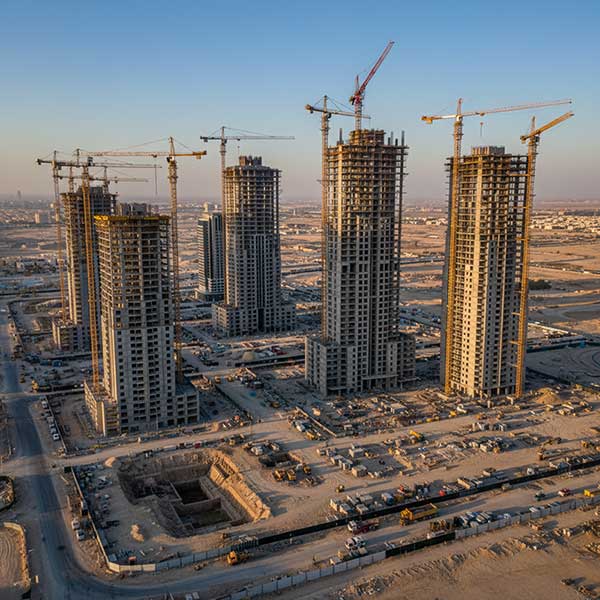
Let’s start with the biggest driver: Saudi Arabia. The Kingdom’s Vision 2030 program, led by Crown Prince Mohammed bin Salman, is fundamentally reshaping the country’s economy — and the construction sector is at the heart of it. Saudi Arabia’s construction market was valued at approximately $180 billion in 2025, with multiple industry forecasts projecting it to surpass $230 billion by 2028. That growth isn’t speculative — it’s backed by projects that are already underway.
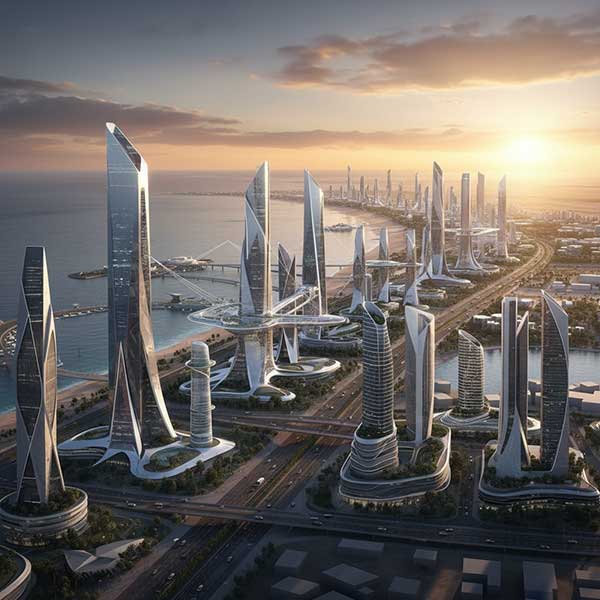
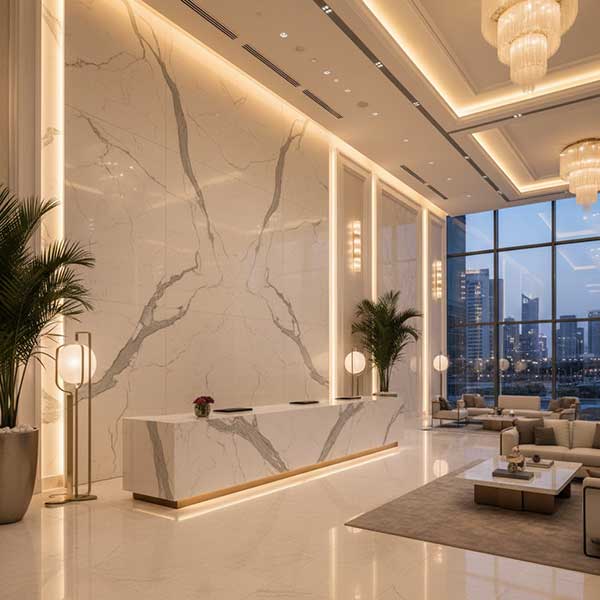
NEOM, the $500 billion futuristic mega-city on the Red Sea coast, is perhaps the most headline-grabbing example. But it’s far from the only one. The Red Sea Global tourism development, Diriyah Gate, Jeddah Central, King Salman Park in Riyadh, and dozens of hotel, residential, and mixed-use projects across the country are all in various stages of construction. Every one of these projects needs interior surfaces — and lots of them. Lobbies, bathrooms, kitchens, elevator surrounds, reception desks, restaurant countertops, and wall cladding panels. Engineered quartz stone checks all the boxes that these projects require: consistency across large quantities, food-safety certifications for hospitality applications, a wide range of marble-look and modern designs, and competitive pricing compared to natural stone.
What Saudi Buyers Are Actually Ordering
From what we’re seeing in our own order data, Saudi Arabian project buyers have clear preferences. Calacatta-style quartz with gold or warm grey veining remains the single most popular category, accounting for roughly 40% of orders. Statuario White with clean grey veining comes in second at about 25%. Interestingly, we’ve seen a noticeable uptick in demand for large-format slabs — 3200×1600mm is increasingly being specified for wall cladding and island countertops, whereas 3050×1440mm used to be the standard request. Thickness-wise, 20mm dominates for countertop applications, while 15mm and even 12mm are being used more often for wall cladding to reduce weight and cost.
There’s also been a clear shift toward polished finishes over honed or matte. This aligns with the luxury aesthetic that dominates Saudi hospitality and high-end residential design — projects in the Kingdom tend to favor a more opulent, glossy look compared to the matte, understated styles popular in Northern Europe.
The UAE Remains a Powerhouse — With Different Dynamics
The UAE, and Dubai in particular, has been a major quartz stone market for years. What’s changed recently is the scale and speed of projects. Expo 2020’s legacy developments, the continued expansion of Dubai Marina and Business Bay, and Abu Dhabi’s Saadiyat Island cultural district are keeping demand consistently high. Unlike Saudi Arabia, where mega-projects create massive one-time orders, the UAE market tends to generate a steadier flow of medium-to-large orders across a broader range of project types.
UAE buyers are also more design-diverse in their requests. While Calacatta is still popular, we see stronger demand for concrete-look quartz, Emperador-style dark browns, and custom colors matched to specific interior design palettes. The UAE market is more mature and design-forward, which means suppliers need to offer a wider color range and be more flexible with customization.
Qatar, Bahrain, and Oman: Smaller but Growing Fast
Qatar’s post-World Cup construction activity hasn’t slowed down as much as some analysts predicted. The country continues to invest in hospitality, commercial, and residential infrastructure. Bahrain’s Diyar Al Muharraq development and Oman’s Muscat waterfront projects are also generating consistent quartz stone demand. While these markets are individually smaller than Saudi Arabia or the UAE, collectively they add meaningful volume — and they tend to be less price-sensitive than some other emerging markets.
How This Boom Is Affecting Global Supply and Pricing
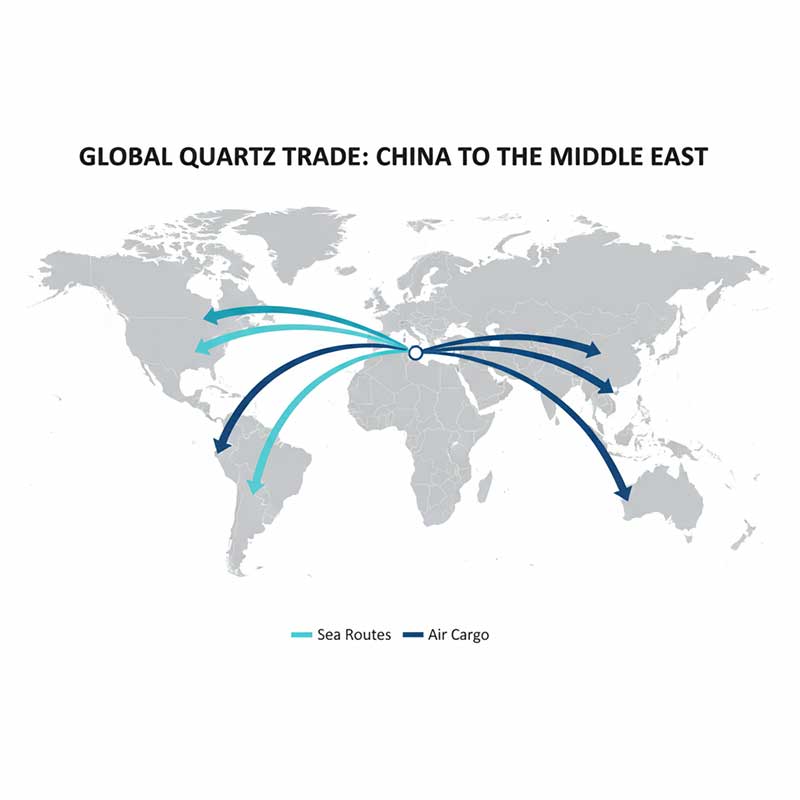
Here’s where things get really interesting for quartz stone importers outside the Middle East. When one region dramatically increases its share of Chinese quartz factory output, it creates ripple effects across the global supply chain.
Production Capacity and Lead Times
Chinese quartz stone factories — particularly in the Guangdong, Fujian, and Shandong manufacturing clusters — operate with finite production capacity. When Middle Eastern project orders surge, production lines get allocated to fulfill those large-volume commitments first. This can extend lead times for smaller orders from other regions. Where a standard order might have shipped in 15–20 days a year ago, some buyers are now seeing 25–30 day lead times during peak periods. If your business depends on just-in-time inventory, this is something to plan around.
FOB Pricing Pressure
Large Middle Eastern project orders often come with aggressive pricing negotiations — buyers are ordering 10, 20, or even 50 containers at a time, which gives them leverage. However, the sheer volume of demand is also absorbing factory capacity that might otherwise chase smaller orders at lower margins. The net effect on FOB pricing has been a modest upward drift of approximately 3–5% across popular Calacatta and Statuario SKUs compared to mid-2025 levels.
Raw Material Implications
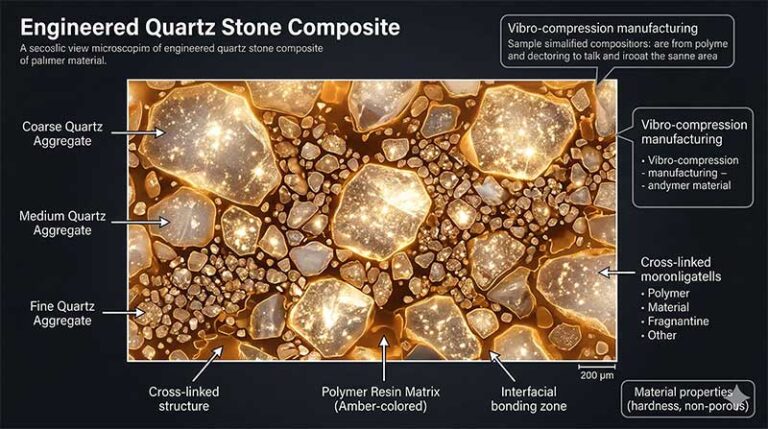
Engineered quartz production relies on crushed quartz aggregate, polyester resin, pigments, and various additives. Resin prices are tied to petrochemical markets, which are themselves influenced by global energy production policy. There’s an indirect feedback loop here: Middle East construction booms are partially funded by energy revenues, while the resin that goes into the quartz slabs they’re ordering is priced partly based on energy costs. So far, resin price increases have been manageable — about 4% year-over-year — but it’s a variable worth watching.
Strategic Takeaways for 2026–2027
The Middle East construction boom is not a short-term blip — it’s a structural shift driven by multi-decade national development strategies with sovereign wealth fund backing. For the global engineered quartz stone trade, this means several things.
First, the overall market is growing. More construction globally means more quartz surfaces needed, which supports the health of the entire industry. Second, supply chain planning matters more than ever. Buyers who communicate their needs early, confirm production slots in advance, and maintain open lines of communication with their factory partners will navigate capacity constraints more smoothly than those who order reactively.
Third, product diversification is a smart hedge. If your business has been heavily concentrated in Calacatta-style products, consider broadening your range. Concrete-look, terrazzo, and solid-color quartz products face less supply competition and are growing in popularity in many markets. Finally, logistics flexibility helps. Being open to partial shipments, alternative port routings, or consolidated container solutions can reduce the impact of shipping cost volatility.
How We’re Responding as a Manufacturer
On our end, we’ve made several investments to keep pace with growing demand. In Q4 2025, we commissioned a second pressing line at our Guangdong facility, adding approximately 30% more monthly slab production capacity. We’ve also expanded our color development team to bring new designs to market faster — particularly in the premium marble-look category where Middle Eastern demand is strongest. Our logistics team now includes dedicated coordinators for GCC shipments, ensuring that container loading schedules, port documentation, and customs clearance run as smoothly as possible.
For our existing partners in all regions, our commitment remains the same: transparent communication on lead times, consistent quality control, and competitive pricing that reflects our scale advantages. If you’re feeling the effects of a tighter supply environment, reach out to your account manager — we’d rather help you plan ahead than have you scramble at the last minute.
The Bottom Line
The Middle East construction boom is reshaping the global engineered quartz stone market in real time. It’s creating tremendous opportunities for manufacturers and suppliers who can scale to meet demand, while also introducing new dynamics that buyers everywhere need to understand and plan for. The companies that will thrive in this environment are the ones that stay informed, plan proactively, and build strong supplier relationships grounded in transparency and mutual long-term interest.