
1. Why Thickness Matters in Engineered Quartz Stone
When sourcing engineered quartz stone for large-scale B2B projects — whether for residential countertop distribution, hospitality fit-out, or multi-unit property development — the slab thickness is one of the most consequential specifications you will define. It affects not only the structural integrity and visual presence of the installed surface, but also cascades through every downstream consideration: freight weight per container, fabrication tool wear, installation labor requirements, and ultimately the total landed cost per square meter at your warehouse.
Unlike natural stone, where thickness is constrained by the geological characteristics of the quarried block and the limitations of gang saw technology, engineered quartz is manufactured under controlled factory conditions using Breton-type compaction presses. This means the thickness is determined at the production stage with high precision, typically within a tolerance of ±0.5 mm across the entire slab surface. This manufacturing consistency is one of the key advantages of engineered quartz over natural granite or marble, as described by the Natural Stone Institute's technical resources.
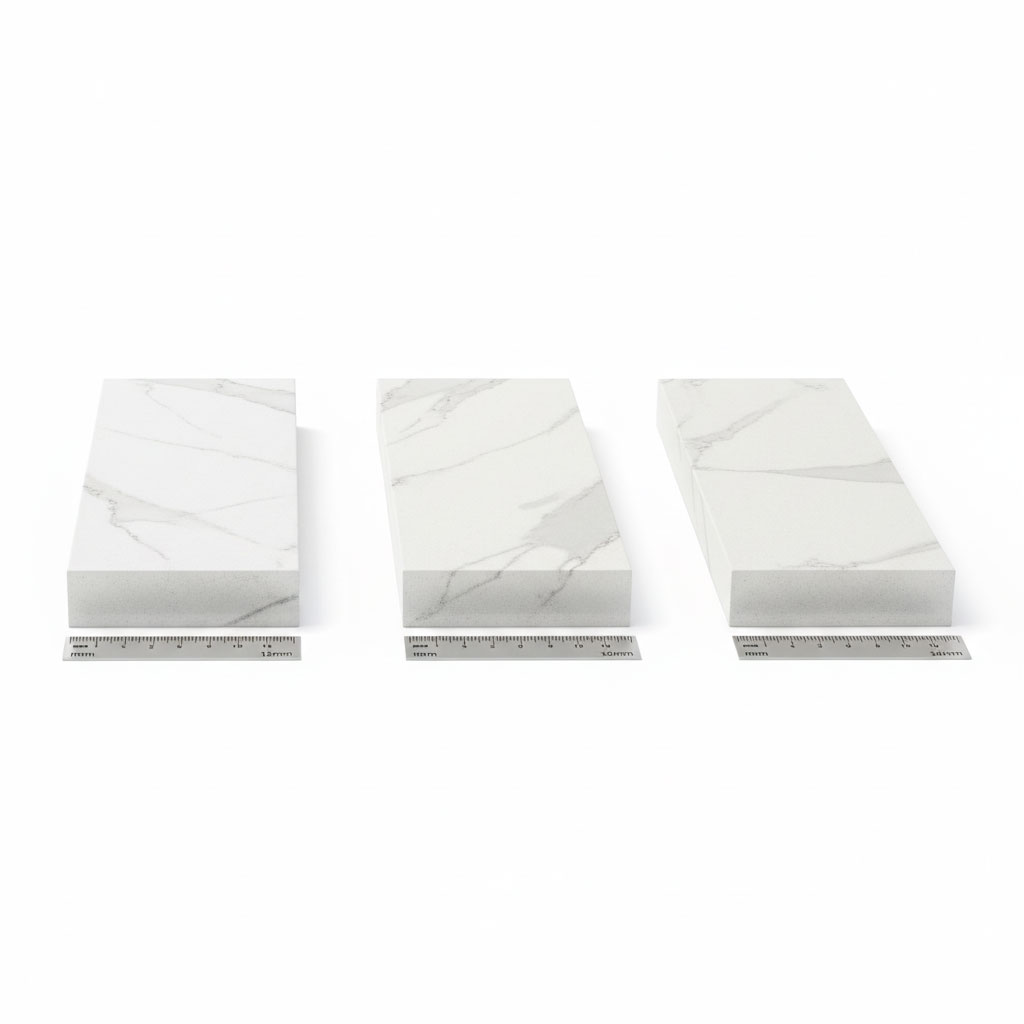
There are three primary dimensions through which thickness influences your sourcing decisions. The first is structural performance. Flexural strength — the ability of the slab to resist bending without fracture — is directly proportional to the square of the thickness. This means that a 20 mm slab is not merely 67% stronger than a 12 mm slab; the bending resistance actually increases by a factor related to the thickness ratio squared. In practical terms, this determines how far a countertop can overhang its cabinet base without support brackets, and how large an unsupported span it can bridge between base units.
The second dimension is logistics and cost efficiency. A standard Breton-pressed slab measuring 3200 × 1600 mm weighs approximately 30 kg/m² at 12 mm thickness, 50 kg/m² at 20 mm, and 75 kg/m² at 30 mm. When you multiply these differences across a full 20-foot container — which typically carries 10 to 15 crated bundles depending on configuration — the impact on ocean freight cost per usable square meter is dramatic. Buyers importing to destinations with high shipping rates, such as South America or Africa, find that thickness selection can represent a 15–25% swing in their total CIF (Cost, Insurance, and Freight) pricing.
The third dimension is aesthetic perception and market positioning. In the North American market, 30 mm (approximately 1¼ inch) countertops are associated with premium kitchens and luxury hospitality brands. In the European market, 20 mm is the dominant standard with 12 mm growing for wall applications. In the Middle Eastern market, 20 mm is standard but 30 mm is increasingly specified for palace and villa projects. Understanding the thickness preferences of your target market ensures that you stock the right specification to meet demand without excess inventory.
2. Industry Standards & Testing for Quartz Slab Thickness
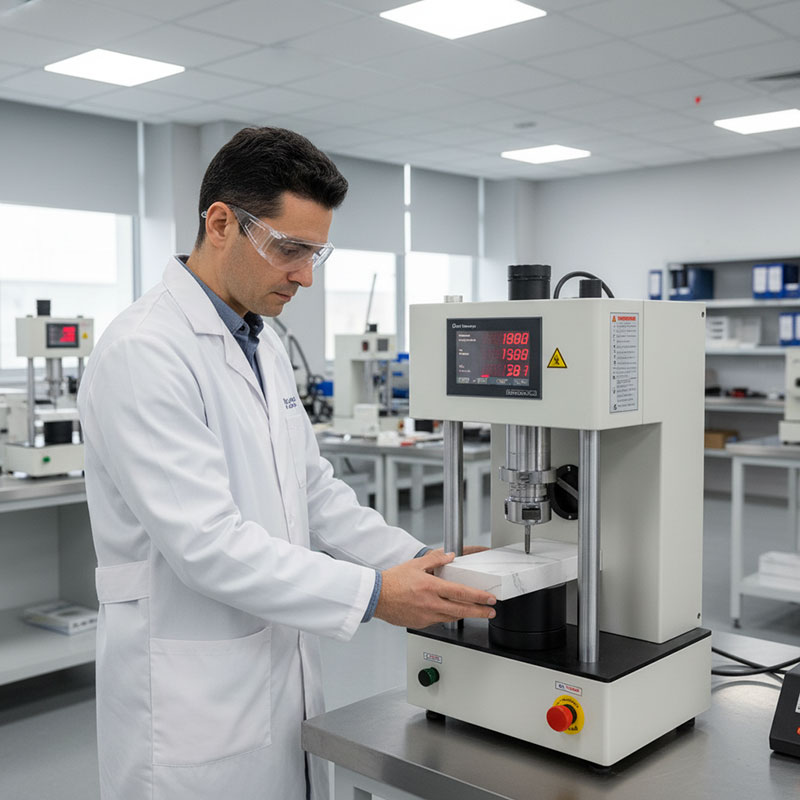
Before diving into the specifics of each thickness option, it is important to understand the international testing frameworks that govern engineered quartz performance. These standards ensure that regardless of thickness, the material meets minimum benchmarks for strength, dimensional accuracy, and safety. As a B2B buyer, referencing these standards in your purchase specifications adds a layer of quality assurance and gives you leverage during factory audits.
ASTM C1722 – The North American Benchmark
ASTM C1722/C1722M is the Standard Specification for Quartz Countertop Slabs published by ASTM International. It establishes minimum requirements for physical and mechanical properties including flexural strength, water absorption, abrasion resistance, and dimensional tolerances. Under this standard, the minimum flexural strength for engineered quartz is 20 MPa, though most quality Chinese manufacturers consistently achieve 35–60 MPa depending on thickness and composition. The dimensional tolerance for thickness is specified as ±0.5 mm for slabs up to 30 mm — a specification that any reputable factory should meet or exceed.
EN 14617 – The European Framework
For buyers distributing into the European Union market, EN 14617 (Agglomerated Stone — Test Methods) is the relevant series of standards. It comprises multiple parts covering flexural strength (Part 2), abrasion resistance (Part 4), frost resistance (Part 5), and thermal shock resistance (Part 6), among others. EN 14617-2 specifies the flexural strength test methodology using a three-point bending apparatus, which is the most commonly cited mechanical property in quartz slab datasheets. European importers should request EN 14617 test reports rather than ASTM reports for regulatory compliance.
NSF/ANSI 51 – Food Contact Safety
For countertop applications in commercial food preparation environments — restaurants, hotel kitchens, catering facilities — the material should be certified to NSF/ANSI 51 (Food Equipment Materials). This certification confirms that the quartz surface does not leach harmful substances into food and is safe for direct food contact. Thickness does not directly affect NSF certification, but buyers should verify that the specific production batch and color formula have been tested — certification is formula-specific, not factory-wide.
Greenguard Gold – Indoor Air Quality
For residential and commercial interior applications, UL Greenguard Gold certification ensures that the engineered quartz slab meets stringent chemical emission limits for volatile organic compounds (VOCs). This is particularly relevant for LEED-certified building projects where material emissions contribute to indoor air quality credits. Again, this certification applies across all thicknesses but must be verified on a per-product basis.
North America: ASTM C1722 + NSF/ANSI 51 + Greenguard Gold
Europe: EN 14617 series + CE marking (where applicable) + REACH compliance
Middle East: ASTM C1722 is commonly accepted; some projects reference GSO standards
Australia: Manufacturers often provide both ASTM and EN test reports for compliance
3. 12mm Quartz – Thin Format for Walls, Backsplash & Lightweight Applications
12 mm (approximately ½ inch) engineered quartz represents the thinnest standard option available from the majority of Chinese manufacturers. Over the past decade, this thickness has evolved from a niche product used primarily for wall cladding into a mainstream specification that accounts for an increasingly significant share of global quartz exports. This growth has been driven by three converging trends: the architectural preference for large-format thin surfaces inspired by porcelain slab aesthetics, the B2B buyer's constant pressure to reduce landed material costs for high-volume projects, and advancements in adhesive and substrate backing technologies that have expanded the viable application range of thinner slabs.
Primary Applications for 12mm Quartz
Vertical Wall Cladding & Feature Walls
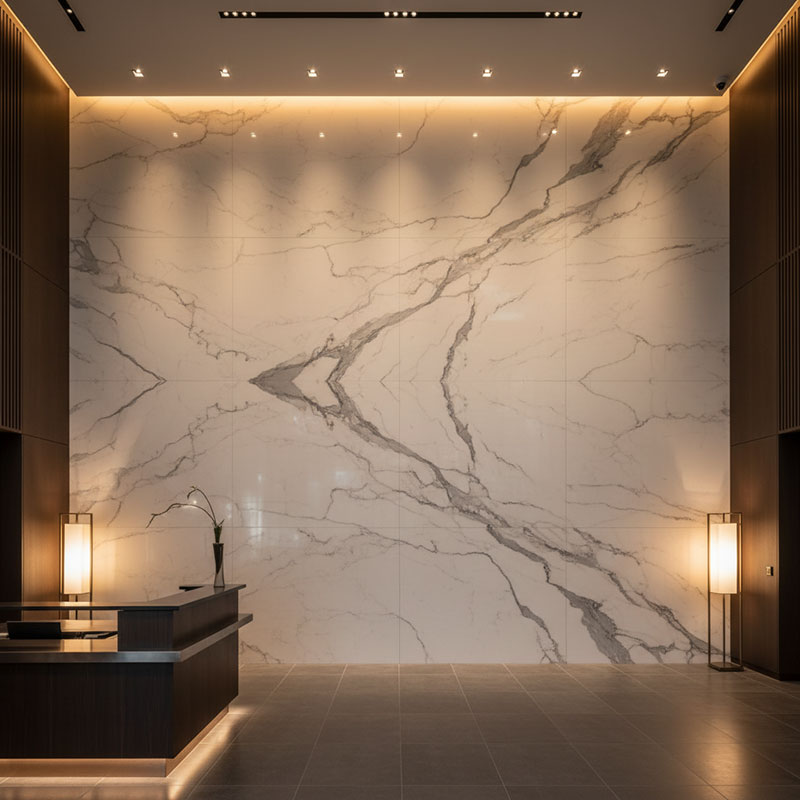
The single most compelling application for 12 mm quartz is vertical surface cladding. At approximately 30 kg/m², a 12 mm slab weighs 40% less than its 20 mm counterpart. This weight reduction is not merely a convenience — it fundamentally changes the structural requirements of the installation. Lighter slabs exert less gravitational shear force on the adhesive bond line, which means they can be installed on a wider range of wall substrates including standard drywall with appropriate reinforcement, concrete block, and cement board. For hotel lobby feature walls, office reception areas, elevator interiors, and luxury retail environments where designers demand large, seamless stone surfaces without visible joints, 12 mm quartz delivers the visual impact of natural stone at a fraction of the weight and cost.
The installation methodology for vertical 12 mm quartz cladding typically follows one of two approaches. The first is direct adhesive bonding using a high-performance two-component epoxy or polyurethane adhesive applied in a notched trowel pattern directly to the prepared substrate. This method works well for wall areas below 3 m² per panel and substrates with adequate flatness (±3 mm over 2 m). The second approach, preferred for larger panels and higher-traffic commercial environments, uses a mechanical fixing system with concealed clips or channels — similar to the ventilated façade systems described by organizations like the Buildings.com technical resources. These mechanical systems provide redundant support and allow for easier panel replacement if damage occurs.
Backsplash Panels
Kitchen and bathroom backsplashes are an ideal application for 12 mm quartz. The thinner profile creates a more refined, contemporary appearance when the backsplash meets the countertop edge — eliminating the visual bulk that can occur with thicker material in this transition zone. For large hospitality projects requiring hundreds of identical backsplash panels, the 12 mm specification offers dual savings: lower per-square-meter material cost and higher container loading density, which reduces the shipping cost allocated to each panel.
Furniture, Cabinetry & Custom Applications
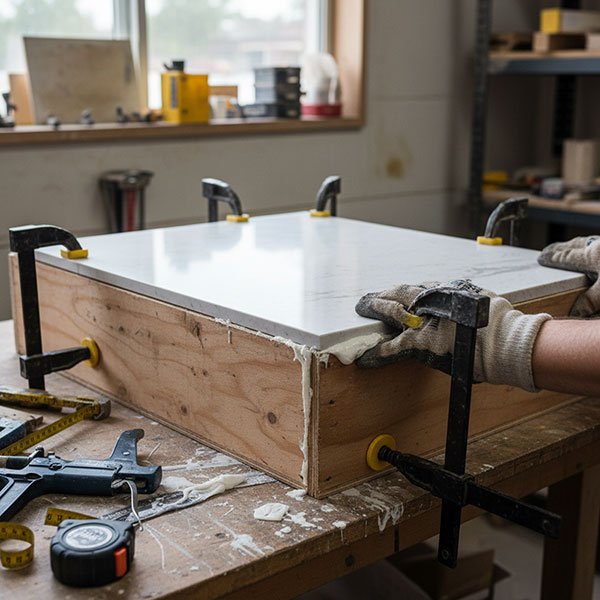
12 mm quartz has found growing application in custom furniture fabrication: tabletops, sideboard surfaces, bathroom shelving, reception desk surfaces, and retail display fixtures. When used for horizontal furniture surfaces, the slab is typically bonded to a substrate — commonly 18 mm plywood, honeycomb aluminum composite panel, or even a high-density foam core — using structural epoxy. This composite approach combines the aesthetic surface quality and hygienic properties of quartz with the structural rigidity and reduced weight of the backing material.
Structural & Engineering Specifications
The flexural strength of 12 mm quartz typically ranges from 35 to 45 MPa, measured according to ASTM C1722 or EN 14617-2. While this is adequate for vertical applications and substrate-backed horizontal surfaces, it imposes clear limitations on unsupported horizontal spans. For countertop applications where 12 mm quartz is used (typically with a laminated edge to mimic thicker material), a continuous cabinet substrate or plywood support layer is essential. Unsupported overhangs should not exceed 150 mm — and ideally should be limited to 100 mm — without concealed steel support brackets fabricated beneath the overhang.
The Mohs hardness of the quartz surface (typically 6–7) is unaffected by thickness, meaning scratch resistance is identical across 12, 20, and 30 mm options. Similarly, the non-porous surface characteristics — water absorption below 0.03% per EN 14617-1 — remain consistent regardless of thickness, as this is a property of the resin-bound quartz matrix rather than the slab dimensions.
When using 12 mm quartz for countertop applications, fabricators commonly apply a "buildup strip" — a 40–60 mm wide strip of the same material bonded to the underside of the slab edge with color-matched epoxy. The visible edge is then profiled and polished to create the appearance of a 20 mm or even 30 mm solid edge. This technique offers the logistics advantages of thin material (more slabs per container) with the visual presence of thicker stone. Ensure your fabricator has experience with mitered edge joints to achieve a seamless result.
| Specification | 12mm Details |
|---|---|
| Actual Thickness | 11.5 – 12.5 mm (tolerance ±0.5 mm) |
| Weight per m² | ~28 – 32 kg |
| Standard Slab Sizes | 3200 × 1600 mm · 3000 × 1400 mm |
| Slab Weight (3200×1600) | ~143 – 164 kg per slab |
| Flexural Strength | 35 – 45 MPa (ASTM C1722) |
| Water Absorption | ≤ 0.03% |
| Max Unsupported Overhang | ~100 – 150 mm |
| Primary Applications | Wall cladding · backsplash · furniture · substrate-backed countertops |
| 20ft Container Loading | ~12 – 15 bundles (~180 – 220 slabs) |
| Price Position | ~15 – 20% below 20 mm base price |
4. 20mm Quartz – The Global Industry Standard
20 mm (approximately ¾ inch) engineered quartz is the undisputed industry standard worldwide. It represents the convergence point where structural performance, manufacturing efficiency, fabrication compatibility, and cost optimization all align. When Chinese quartz factories quote pricing, the 20 mm specification is invariably the reference point — the base price from which other thicknesses are calculated as premiums or discounts. When fabrication shops calibrate their CNC bridge saws, edge profilers, and waterjet machines, 20 mm is the default thickness setting. When architects write specifications for commercial projects without a strong design reason to deviate, 20 mm is the thickness they specify.
Why 20mm Dominates Global Market Share
Manufacturing Optimization
The Breton Bretonstone production line — the technology used by approximately 85% of engineered quartz manufacturers worldwide — is engineered to produce 20 mm slabs at maximum throughput efficiency. The vibro-compression vacuum process applies approximately 100 tonnes of pressure while simultaneously evacuating air from the quartz-resin mixture. The press cycle time, vacuum duration, and resin cure parameters are all optimized for the 20 mm profile. While the same equipment can produce 12 mm and 30 mm slabs with adjusted settings, 20 mm production achieves the highest yield per shift and the lowest defect rate. This manufacturing reality translates directly into shorter lead times, broader color availability, and the lowest per-square-meter factory gate price for buyers.
Structural Versatility
At 20 mm, engineered quartz achieves a flexural strength of 45–55 MPa — sufficient for the vast majority of residential and commercial countertop applications without any substrate backing. A 20 mm slab can safely span an unsupported overhang of approximately 300 mm (12 inches) in standard kitchen counter configurations, which accommodates seating overhangs on peninsula counters and standard breakfast bar extensions. This span capability means that for most standard kitchen layouts, the quartz can be installed directly on cabinet boxes without the added cost and complexity of a plywood substrate — a significant labor and material saving at the project level.
Global Fabrication Ecosystem
The worldwide network of stone fabrication shops — from large industrial operations with multiple CNC lines to small independent workshops with a single bridge saw — is overwhelmingly configured for 20 mm material. Saw blade heights, vacuum cup lifter capacities, edge polishing roller configurations, and even the ergonomic design of fabrication tables are all dimensioned around the 20 mm standard. When you supply 20 mm slabs to your distribution network, you ensure maximum compatibility with every fabricator in your market, minimizing the risk of fabrication errors, tool incompatibility, or installation delays.
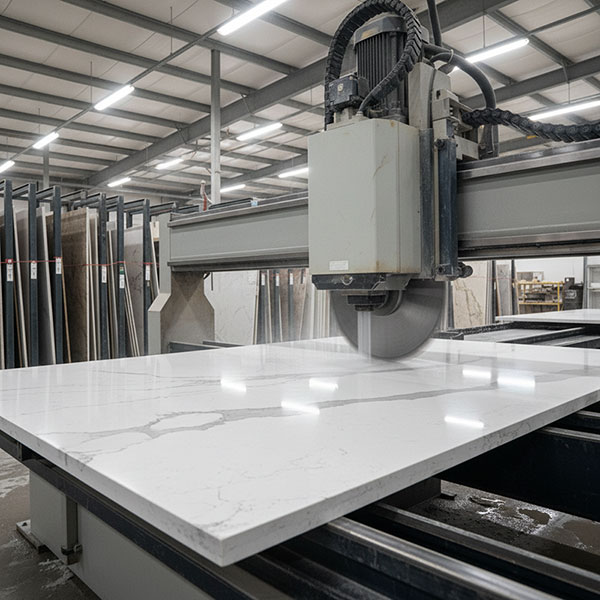
Application Range – Residential
Kitchen countertops are the single largest application segment for 20 mm quartz, accounting for an estimated 55–60% of total global demand according to industry analysis from Freedonia Group market research. The standard kitchen counter configuration — a 600 mm deep slab with 20–40 mm front overhang and 0–5 mm rear wall gap — is perfectly served by 20 mm material. Bathroom vanity tops represent the second-largest residential application, followed by shower niches, tub surrounds, fireplace surrounds, and laundry room counters.
In the residential market, 20 mm quartz offers the broadest palette of design options. Because it is the highest-volume production thickness, manufacturers invest their most sophisticated pattern and vein technologies in 20 mm products. The latest generation of engineered quartz patterns — hyperrealistic marble veining produced by multi-layer ink deposition and translucent vein pigments — is typically developed first (and sometimes exclusively) for 20 mm slabs before being adapted to other thicknesses.
Application Range – Commercial & Hospitality
In commercial environments, 20 mm quartz serves an exceptionally diverse range of applications. Restaurant and café tabletops benefit from the material's non-porous, stain-resistant surface — which resists coffee, wine, and acidic food stains far more effectively than natural marble (a material traditionally used in café settings but requiring frequent sealing). Laboratory work surfaces in healthcare and educational facilities leverage the chemical resistance of quartz — it withstands common laboratory reagents including dilute acids and bases, as documented in manufacturer chemical resistance data sheets.
Hotel brands in the midscale and upper-midscale segments — such as Marriott's Courtyard brand, Hilton's Hampton brand, and IHG's Holiday Inn Express — almost universally specify 20 mm for both guest room vanity tops and public area surfaces. The consistency of 20 mm material across hundreds of rooms in a single hotel ensures uniform appearance, simplifies procurement, and keeps project budgets manageable. For a 200-room hotel requiring approximately 400–500 m² of quartz surfaces, the cost difference between 20 mm and 30 mm can exceed $8,000–$15,000 in material alone, before considering the additional fabrication and installation premium for heavier slabs.
| Specification | 20mm Details |
|---|---|
| Actual Thickness | 19.5 – 20.5 mm (tolerance ±0.5 mm) |
| Weight per m² | ~48 – 52 kg |
| Standard Slab Sizes | 3200 × 1600 mm · 3000 × 1400 mm · 3200 × 1800 mm (jumbo) |
| Slab Weight (3200×1600) | ~246 – 266 kg per slab |
| Flexural Strength | 45 – 55 MPa (ASTM C1722) |
| Water Absorption | ≤ 0.03% |
| Max Unsupported Overhang | ~250 – 300 mm |
| Primary Applications | Kitchen countertops · vanities · commercial · hospitality · lab surfaces |
| 20ft Container Loading | ~8 – 10 bundles (~120 – 150 slabs) |
| Price Position | Base reference price |
When requesting quotations from Chinese manufacturers, always use 20 mm as your baseline specification. Ask for FOB Xiamen or FOB Shanghai pricing for 20 mm first, then request the percentage adjustment for 12 mm and 30 mm. This approach makes it easier to compare across multiple factories and identify which manufacturers offer the most competitive pricing at each thickness tier.
5. 30mm Quartz – Premium Luxury Grade
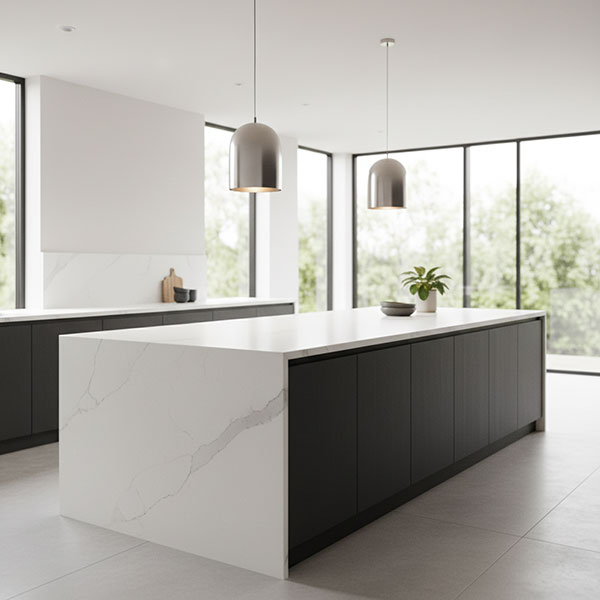
30 mm (approximately 1¼ inch) engineered quartz occupies the premium tier of the product range. It is specified when the project demands a visual statement of substance, permanence, and luxury — where the countertop edge itself becomes a design element and the physical mass of the material contributes to the sensory experience of the space. In the hierarchy of interior surface materials, a 30 mm quartz countertop with a precision-polished square edge or a dramatic waterfall application occupying an entire island end panel communicates the same level of investment and intentionality as solid hardwood flooring or handcrafted cabinetry.
Where 30mm Quartz Creates Maximum Impact
Luxury Kitchen Islands
The large kitchen island — typically 2400 mm × 1000 mm or larger in high-end residential design — is the signature application for 30 mm quartz. The additional 10 mm of visible edge thickness compared to 20 mm may seem modest in absolute terms, but the visual difference is pronounced, particularly when combined with a square or eased edge profile that displays the full thickness without tapering or rounding. The 30 mm profile also enables longer unsupported overhangs for seating areas: up to 400–450 mm without bracket support in most cases, compared to 250–300 mm for 20 mm. This allows designers to create generous breakfast bar extensions without visible support hardware.
Waterfall Edge Applications
The waterfall edge — where the countertop surface cascades vertically down one or both ends of an island to the floor — is one of the most impactful uses of 30 mm quartz. The continuous vein pattern that flows from horizontal to vertical creates a dramatic visual effect, and the thicker slab makes the mitered joint at the corner more robust and less visible. Fabricators report that 30 mm waterfall edges are significantly easier to execute with clean joints than 20 mm, because the additional material at the miter provides more bonding surface area and the joint is less prone to chipping during dry-fitting.
Five-Star Hospitality & Signature Commercial
International luxury hotel brands — Four Seasons, Ritz-Carlton, St. Regis, Waldorf Astoria — frequently specify 30 mm quartz for high-visibility surfaces including reception desks, concierge counters, bar tops, and spa treatment room surfaces. These brands understand that the tactile and visual weight of a thicker countertop contributes to the overall guest perception of quality and luxury. Bar tops in upscale restaurants and lounges similarly benefit from 30 mm material: the additional mass provides better acoustic damping (reducing the hollow sound when glasses and bottles are placed on the surface) and the thicker edge withstands the minor impacts of busy bar service more effectively.
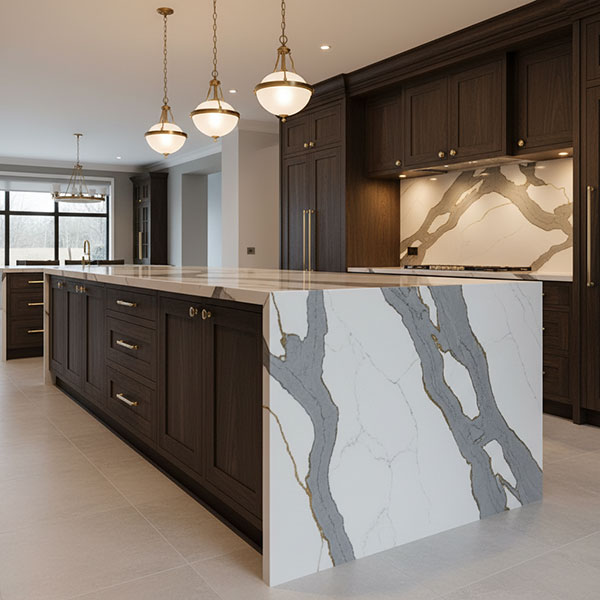
Weight, Logistics & Installation Realities
The practical implications of 30 mm quartz begin with one number: 75 kg/m². A full-size 3200 × 1600 mm slab at 30 mm thickness weighs approximately 384 kg (847 lbs). This weight permeates every stage of the supply chain. At the factory, larger cranes and more robust A-frame storage racks are required. During container loading, the heavier bundles reduce the total number of slabs per container by approximately 30–40% compared to 20 mm. At the destination port and warehouse, heavier equipment and more personnel are needed for unloading and handling.
Installation is where the weight differential has its most visible cost impact. A standard two-person installation crew can handle 20 mm slab sections for most residential installations. But 30 mm sections — particularly large island tops that may weigh 200+ kg as a single piece — often require a three- or four-person crew, or the use of mechanical suction-cup lifters and specialized carry frames. In markets where installation labor is expensive (North America, Western Europe, Australia), this additional labor requirement can add $5–$15 per square meter to the installed cost. In markets where labor is more affordable (Southeast Asia, Middle East), the installation cost premium is less significant.
Despite their greater flexural strength, 30 mm quartz countertops are significantly heavier than 20 mm and require that the supporting cabinetry be engineered for the load. Standard residential cabinetry is designed for 20 mm stone weight. When specifying 30 mm, verify with your cabinet supplier that corner braces, side panels, and mounting hardware are rated for the additional weight — particularly for wall-hung vanity cabinets in bathroom applications. A 30 mm quartz vanity top on a wall-mounted cabinet can exceed 80–100 kg, which requires robust wall anchoring.
| Specification | 30mm Details |
|---|---|
| Actual Thickness | 29.5 – 30.5 mm (tolerance ±0.5 mm) |
| Weight per m² | ~72 – 78 kg |
| Standard Slab Sizes | 3200 × 1600 mm · 3000 × 1400 mm |
| Slab Weight (3200×1600) | ~369 – 400 kg per slab |
| Flexural Strength | 50 – 60 MPa (ASTM C1722) |
| Water Absorption | ≤ 0.03% |
| Max Unsupported Overhang | ~400 – 450 mm |
| Primary Applications | Luxury islands · waterfall edges · 5-star hotel bars · statement pieces |
| 20ft Container Loading | ~5 – 7 bundles (~75 – 100 slabs) |
| Price Position | ~40 – 60% above 20 mm base price |
6. Head-to-Head Thickness Comparison
The following consolidated comparison brings together the key specifications of all three standard thicknesses in a single reference table. This is the data set that informed B2B buyers should use when writing procurement specifications, comparing factory quotations, and calculating project material requirements.
- Weight: ~30 kg/m²
- Strength: 35–45 MPa
- Overhang: ≤150 mm
- Container: 180–220 slabs
- Cost: -15 to -20%
- Best for: Walls, backsplash
- Weight: ~50 kg/m²
- Strength: 45–55 MPa
- Overhang: ≤300 mm
- Container: 120–150 slabs
- Cost: Base price
- Best for: Countertops, vanities
- Weight: ~75 kg/m²
- Strength: 50–60 MPa
- Overhang: ≤450 mm
- Container: 75–100 slabs
- Cost: +40 to +60%
- Best for: Luxury, hospitality
| Property | 12mm | 20mm | 30mm |
|---|---|---|---|
| Actual Thickness Range | 11.5 – 12.5 mm | 19.5 – 20.5 mm | 29.5 – 30.5 mm |
| Weight (3200×1600 slab) | ~153 kg | ~256 kg | ~384 kg |
| Flexural Strength (MPa) | 35 – 45 | 45 – 55 | 50 – 60 |
| Compressive Strength (MPa) | 150 – 200 | 180 – 230 | 180 – 230 |
| Impact Resistance | Lower — requires substrate support | Standard — self-supporting | Highest — excellent durability |
| Countertop Use Without Substrate | Not recommended | Yes — standard practice | Yes — premium practice |
| Wall Cladding Suitability | Excellent — preferred | Possible — heavier | Not practical — too heavy |
| Fabrication Blade Wear | Lowest | Standard | Highest — ~30% more wear |
| Installation Crew Size (typical) | 2 persons | 2 persons | 3–4 persons or mechanical lift |
| Lead Time (standard colors) | 15 – 25 days | 10 – 20 days | 20 – 30 days |
| Color Availability | 70–80% of catalog | 100% of catalog | 50–70% of catalog |
A standard 20-foot container has a usable internal dimension of approximately 5.9 m × 2.35 m × 2.39 m and a maximum payload of approximately 21,700 kg. For quartz slabs crated in wooden A-frame bundles (typically 10–15 slabs per bundle), the limiting factor is usually weight for 30 mm slabs and volume for 12 mm slabs. For 20 mm, weight and volume constraints are roughly balanced, which is another reason this thickness is the most shipping-efficient option on a cost-per-usable-m² basis.
7. Surface Finish Options – Detailed Technical Guide
The surface finish of engineered quartz is the second most critical specification after thickness, and it has a profound impact on both the aesthetic character and the practical performance of the installed surface. Surface finish is determined during the final stage of production: after the slab has been compacted, cured, and calibrated to its target thickness, it passes through a series of abrasive heads on an automated polishing line. The grit sequence and final abrasive type determine the finish level. Understanding these finishes in depth allows B2B buyers to match the product precisely to the end-user's design vision and performance expectations.
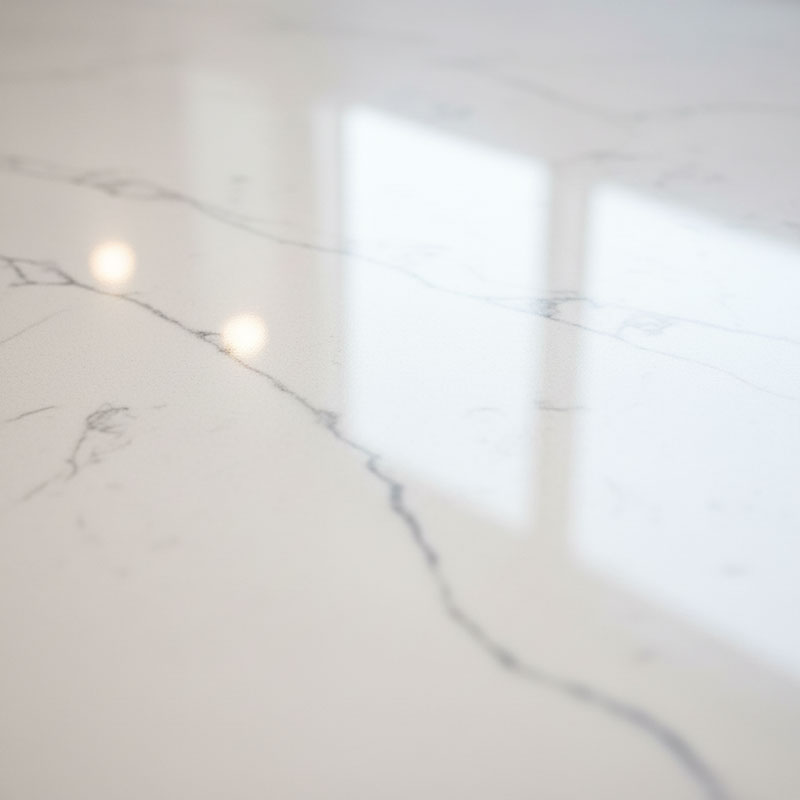
Polished (Glossy) Finish – The Market Leader
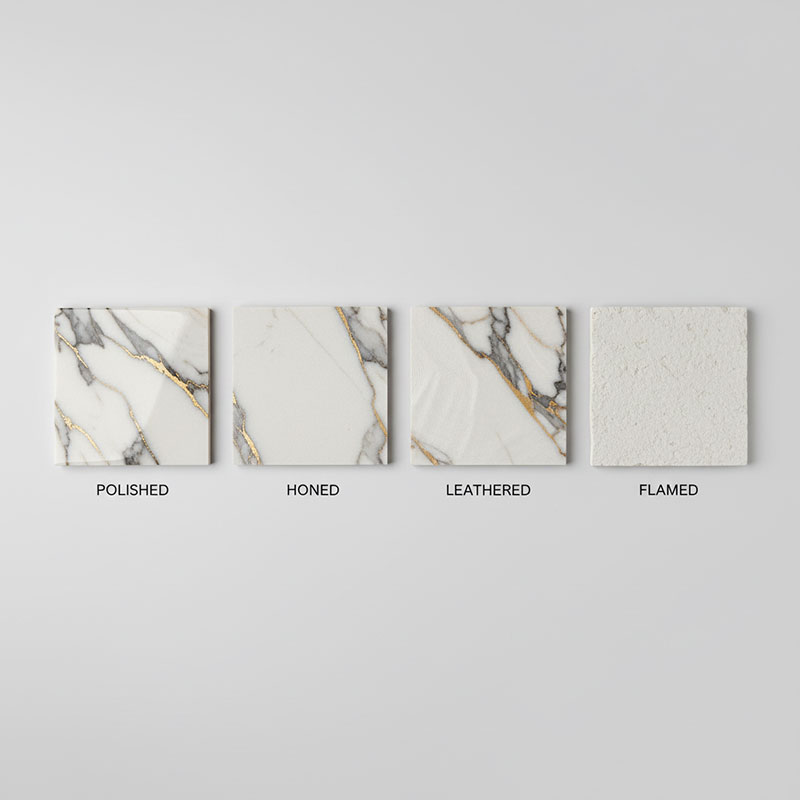
The polished finish accounts for approximately 65–70% of all engineered quartz sold worldwide and remains the default specification for most countertop applications. It is achieved by progressively grinding the slab surface through a sequence of diamond-impregnated resin pads, typically starting at 50 grit for initial calibration and progressing through 100, 200, 400, 800, 1500, and finally 3000 grit for the mirror finish. Some manufacturers add a final buffing stage with felt pads and polishing compound to achieve gloss levels above 90 units.
The resulting surface has a specular reflectance (gloss) of 85–95 GU (Gloss Units, measured at a 60° incidence angle using a glossmeter conforming to ASTM D523). This high gloss enhances the visual depth of the material, making veining patterns appear more three-dimensional and colors more saturated. The polished surface is also the most hygienic finish option: the mirror-smooth surface has virtually no micro-texture for bacteria or mold to colonize, which is why NSF/ANSI 51 certification testing is typically performed on polished samples.
The main practical consideration with polished quartz is that it shows fingerprints, water marks, and fine scratches more readily than textured finishes — particularly in very dark colors (absolute black, deep charcoal) and very light colors with high contrast veining. This is a surface-level optical effect rather than actual material degradation; the "scratches" visible on dark polished quartz are typically minor abrasions in the resin matrix that scatter light differently and can often be buffed out with a fine automotive compound.
Honed (Matte) Finish – The Contemporary Choice
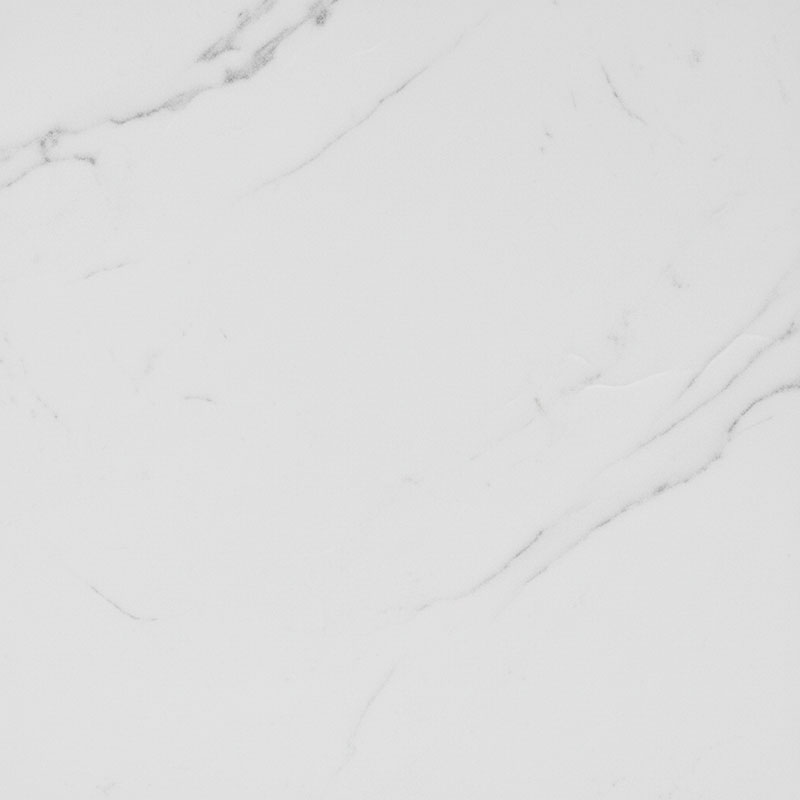
The honed finish has experienced the fastest growth trajectory of any finish type in the past five years, driven by the global design movement toward understated, natural-looking surfaces. Interior design publications like Architectural Digest and Elle Decor have featured honed quartz prominently in their kitchen and bathroom trend reports, describing it as the preferred finish for achieving a "soft, contemporary aesthetic that complements both minimalist and transitional design schemes."
Technically, the honed finish is produced by stopping the polishing sequence at a lower grit level — typically between 200 and 400 grit — resulting in a smooth, flat surface with a soft satin appearance and a gloss level of 20–40 GU. The surface is not rough to the touch; it has the same smoothness as a sheet of fine stationery paper. Colors appear softer and more muted than their polished counterparts, and veining has a more subtle, organic quality that closely mimics honed natural marble — a particularly desirable characteristic for the hugely popular Calacatta and Statuario marble-look quartz patterns.
From a practical standpoint, honed quartz is less likely to show water spots, fingerprints, and light scratches than polished surfaces, making it a pragmatic choice for busy family kitchens and high-traffic commercial environments. However, the slightly more open surface texture (compared to the sealed mirror of a polished surface) means that oil-based stains — olive oil, cooking grease, makeup — can sit in the micro-texture if not cleaned promptly. This is not a permanent staining risk (the quartz matrix is still non-porous), but it does require somewhat more diligent routine cleaning compared to a polished surface.
Not all quartz colors are available in a honed finish as a standard catalog item. Most manufacturers offer polished as the default finish for their entire color range, while honed is available for a subset of popular colors (typically 30–60% of the catalog). For colors outside the standard honed range, a custom honed production run may be required, which typically carries a minimum order quantity of 50–100 slabs and a lead time premium of 5–10 days. Always confirm honed availability for your specific color selections before committing to project specifications.
Leathered (Brushed / Antiqued) Finish – Textured Character
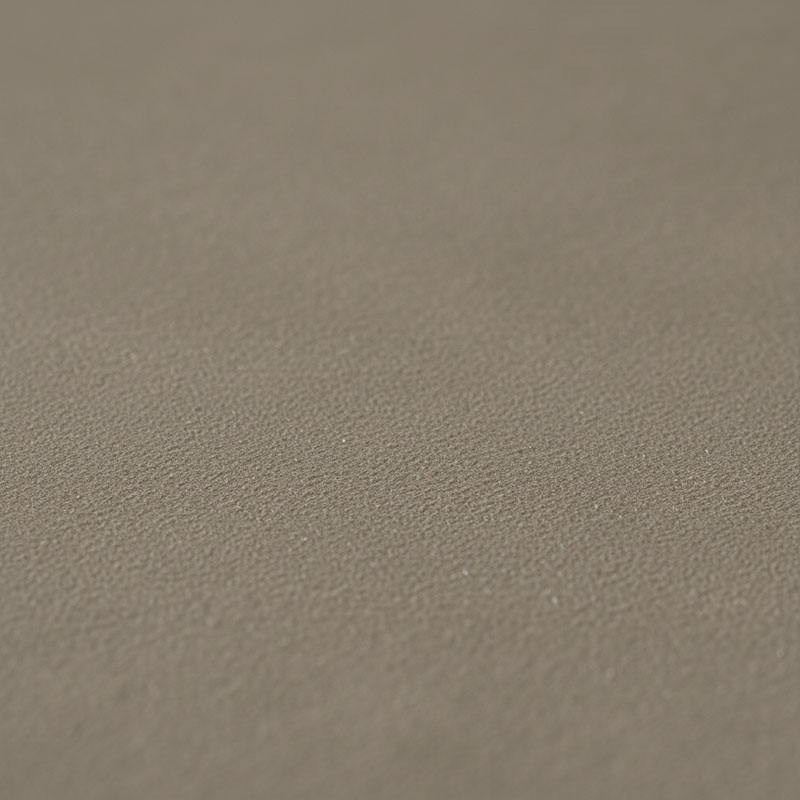
The leathered finish — also marketed as "brushed," "suede," or "antiqued" depending on the manufacturer — introduces a tactile, three-dimensional surface texture that is absent from both polished and honed finishes. The production process involves an additional step after the honing stage: the surface is passed through a set of diamond-tipped brush rollers that selectively abrade the softer resin areas while leaving the harder quartz aggregate particles slightly proud. The result is a surface with subtle undulations that you can feel with your fingertips, reminiscent of the texture of soft leather or natural stone that has been weathered over centuries.
The gloss level of leathered quartz ranges from 10–25 GU, making it the least reflective of the three standard finishes. This low reflectance, combined with the micro-textured surface, makes it exceptionally forgiving in daily use: fingerprints, water spots, minor scratches, crumbs, and light dust are virtually invisible. For high-traffic commercial surfaces — restaurant bar tops, hotel check-in counters, and retail cash wraps where continuous use makes frequent cleaning impractical — the leathered finish offers a significant maintenance advantage.
Aesthetically, the leathered finish pairs particularly well with warm, earthy quartz colors — concrete grey, warm taupe, stone beige, and dark granite-look patterns. It is less commonly specified for white marble-look patterns, as the textured surface can interfere with the crisp vein definition that is central to the marble aesthetic. However, some manufacturers have developed a "soft leather" variant with a finer texture that preserves more vein detail, expanding the viable color range for this finish type.
Rough / Flamed Finish – Specialty Applications
The rough or flamed finish is the least common of the standard options, representing less than 5% of total quartz production. It produces a pronounced, non-slip surface texture that is primarily specified for flooring applications, outdoor paving (in conjunction with UV-stable quartz formulations), and decorative wall panels where a highly tactile, artisanal character is desired. The texture is created through high-pressure water jet treatment, mechanical bush-hammering, or a combination of both processes applied to the calibrated slab surface.
The anti-slip properties of flamed quartz make it relevant for commercial flooring applications governed by slip-resistance standards such as ASTM C1028 (static coefficient of friction) or the European DIN 51130 pendulum test. A flamed quartz surface can achieve a dynamic coefficient of friction (DCOF) of 0.60 or higher — well above the 0.42 minimum recommended by ANSI A137.1 for level interior surfaces.
| Finish | Gloss (GU) | Touch | Shows Marks? | Best Applications | Availability |
|---|---|---|---|---|---|
| Polished | 85 – 95 | Mirror-smooth | Yes — water spots, fingerprints | Countertops, vanities, all surfaces | 100% of colors |
| Honed | 20 – 40 | Smooth satin | Minimal — oil stains need attention | Contemporary kitchens, bathrooms | 30–60% of colors |
| Leathered | 10 – 25 | Soft texture | Very low — hides imperfections | High-traffic commercial, rustic design | 20–40% of colors |
| Rough/Flamed | 5 – 15 | Pronounced texture | Lowest — debris in texture | Flooring, outdoor, decorative walls | Custom order only |
8. Edge Profiles & How Thickness Affects Your Options
The edge profile — the shape applied to the visible front edge of a countertop — is the design detail where slab thickness has its most tangible visual impact. While the flat surface of a countertop looks identical regardless of thickness (the pattern and finish are surface characteristics), the edge is where thickness becomes visible and touchable. The choice of edge profile should be considered in conjunction with thickness selection, as certain profiles are only practical or aesthetically successful at specific thicknesses.
Common Edge Profiles by Thickness Suitability
Square / Eased Edge
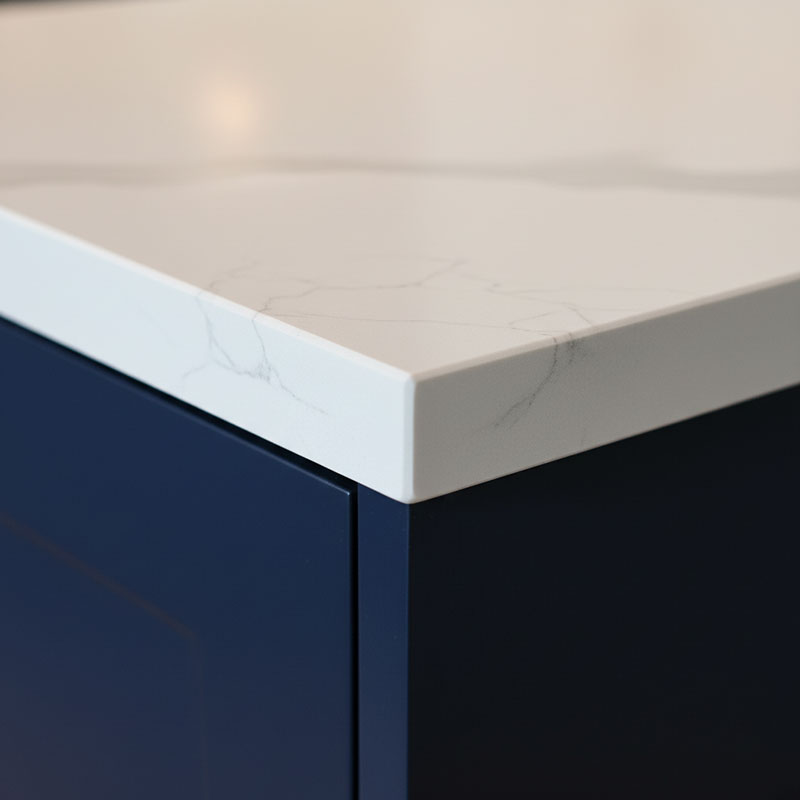
The square edge (also called "flat" or "eased") is the simplest and most contemporary profile: a flat vertical face with a very slight rounding (1–2 mm radius) on the top and bottom arrises to prevent chipping. This profile puts the full thickness on display, making it the preferred choice for 30 mm slabs where the substantial edge becomes a design feature. At 20 mm, a square edge is clean and professional. At 12 mm, it can look thin unless a buildup strip is used. The square edge also works exceptionally well with waterfall applications, where the clean 90° transition from horizontal to vertical surface is a key design element.
Beveled Edge
The beveled edge features a small 45° chamfer (typically 3–6 mm) on the top arris. This creates a subtle shadow line and a more refined, less industrial appearance than a pure square edge. It is popular in both 20 mm and 30 mm applications and is one of the fastest edge profiles to fabricate — requiring a single pass on the edge polishing line — making it a cost-effective choice for high-volume commercial projects.
Bullnose (Full Round) Edge
The full bullnose is a completely rounded edge profile that creates a soft, traditional appearance. This profile is most visually proportionate at 20 mm and 30 mm thicknesses. At 12 mm, a full bullnose appears overly narrow and can be fragile at the rounded apex. The bullnose is popular in traditional and transitional kitchen designs and in healthcare environments where the rounded edge reduces the risk of injury from sharp corners.
Ogee Edge
The ogee is an ornamental S-curve profile that imparts a classical, decorative character. It requires a minimum of 20 mm material to execute properly, with 30 mm providing the most dramatic and proportionate result. The ogee is more time-consuming to fabricate and is typically specified for high-end residential projects. Due to the complex curve geometry, it is also more challenging to polish uniformly, so buyers should expect a small premium for ogee edge fabrication.
Mitered / Laminated Edge
As discussed in the 12 mm section, a mitered (or laminated) edge involves bonding a strip of material to the underside of the slab edge to create the appearance of greater thickness. This technique is used most commonly with 12 mm material to simulate a 20–30 mm edge, but it is also used with 20 mm material to create a dramatic 40–60 mm deep edge that conveys ultra-premium luxury. The mitered joint should be virtually invisible when executed by an experienced fabricator using color-matched adhesive.
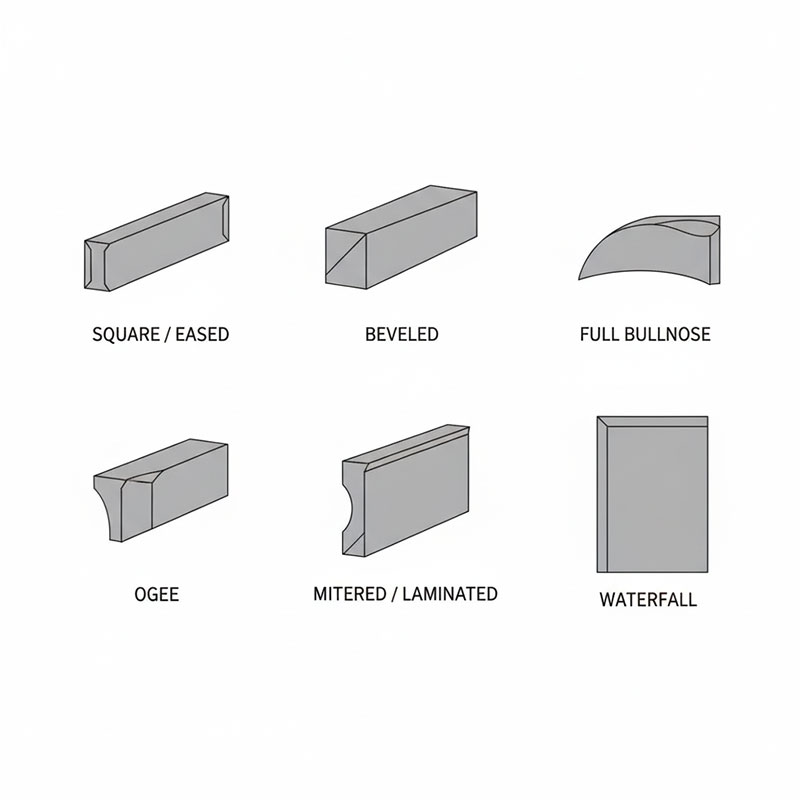
| Edge Profile | 12mm | 20mm | 30mm | Fabrication Cost |
|---|---|---|---|---|
| Square / Eased | ✅ With buildup | ✅ Clean, modern | ✅ Dramatic, premium | Low |
| Beveled | ⚠️ Minimal visual effect | ✅ Popular standard | ✅ Refined, elegant | Low |
| Bullnose | ❌ Too thin | ✅ Proportionate | ✅ Bold, traditional | Medium |
| Ogee | ❌ Not feasible | ✅ Minimum thickness | ✅ Ideal, classical | High |
| Mitered / Laminated | ✅ Primary technique | ✅ For ultra-thick look | ⚠️ Rarely needed | High |
| Waterfall (island end) | ⚠️ Fragile joint | ✅ Standard | ✅ Strongest joint | High |
9. Comprehensive Cost & Logistics Analysis
For B2B buyers, the true cost of engineered quartz is never the FOB factory price alone. The complete cost equation encompasses the FOB slab price, ocean freight (heavily influenced by weight and container utilization), port handling and customs duties, inland trucking to your warehouse, local fabrication, and installation labor. Thickness influences nearly every component of this equation. The following analysis provides a framework for calculating the total landed and installed cost per square meter for each thickness option.
FOB Factory Pricing Structure
As of early 2025, indicative FOB pricing from established Chinese quartz manufacturers (Guangdong and Fujian provinces) for standard solid colors and simple vein patterns follows the general ranges shown below. Premium patterns such as full-slab Calacatta veining, bookmatched designs, and translucent-vein formulations command a 2–3× premium above these base ranges. Ultra-budget "builder grade" colors can fall below these ranges but may come with compromises in consistency and quality control.
| Cost Component | 12mm | 20mm | 30mm |
|---|---|---|---|
| FOB Price – Standard Colors | $12 – $35 /m² | $15 – $45 /m² | $25 – $72 /m² |
| FOB Price – Premium Patterns | $30 – $65 /m² | $40 – $85 /m² | $65 – $130 /m² |
| Ocean Freight (to US East Coast) | ~$2.50 – $4.50 /m² | ~$4.00 – $7.00 /m² | ~$7.00 – $12.00 /m² |
| Ocean Freight (to Latin America) | ~$3.00 – $5.50 /m² | ~$5.00 – $8.50 /m² | ~$8.00 – $14.00 /m² |
| Ocean Freight (to Europe) | ~$2.00 – $4.00 /m² | ~$3.50 – $6.50 /m² | ~$6.00 – $10.00 /m² |
| Customs Duty (varies by country) | Typically 0–12% ad valorem depending on HS code and trade agreements | ||
| Local Fabrication (cut, edge, polish) | $15 – $30 /linear m | $18 – $35 /linear m | $25 – $50 /linear m |
| Installation Labor | $8 – $15 /m² (may need substrate) | $10 – $20 /m² | $15 – $30 /m² (extra crew) |
Container Utilization & Shipping Economics
Container utilization is one of the most under-analyzed factors in quartz procurement, yet it can shift the effective per-m² cost by 10–20%. The standard shipping unit is a wooden A-frame crate (also called a "bundle") containing 10–15 slabs, depending on thickness. These crates are loaded into standard 20-foot dry containers, which have a maximum payload of approximately 21,700 kg and internal dimensions of 5.9 m (L) × 2.35 m (W) × 2.39 m (H).
For 12 mm slabs, the container is typically volume-limited rather than weight-limited. You can physically fit 12–15 bundles (180–220 slabs, representing approximately 920–1,130 m² of material) before reaching the weight limit. This high density of material per container makes 12 mm the most shipping-efficient option on a per-m² basis.
For 20 mm slabs, weight and volume constraints are approximately balanced. A typical load is 8–10 bundles (120–150 slabs, approximately 615–770 m²). This balanced utilization is one reason 20 mm has the most predictable and consistent shipping economics.
For 30 mm slabs, the container is weight-limited. Despite having physical space for more material, the 21,700 kg payload limit restricts loading to approximately 5–7 bundles (75–100 slabs, approximately 384–512 m²). The per-m² freight cost is therefore 50–80% higher than for 20 mm, even though the freight rate for the entire container is identical.
For buyers ordering mixed thickness loads, consider combining 30 mm and 12 mm slabs in the same container to optimize weight utilization. Place the heavier 30 mm bundles at the bottom and fill the remaining volume/weight capacity with lighter 12 mm bundles. This "mixed loading" strategy can reduce the effective per-m² freight cost for 30 mm material by 15–25% compared to shipping a container of 30 mm exclusively.
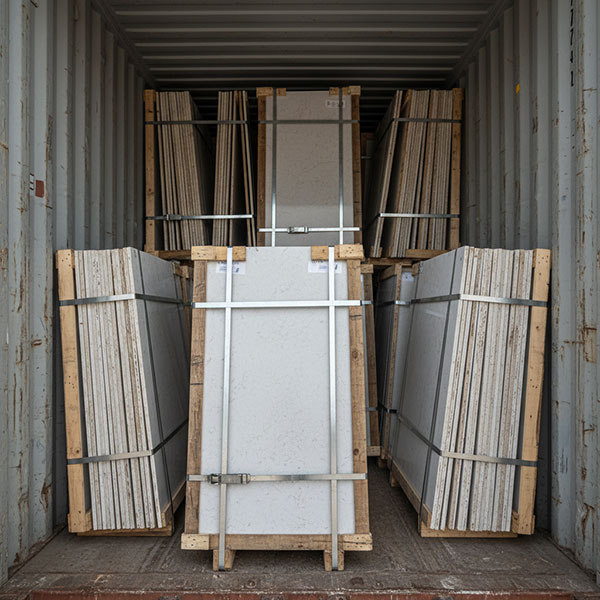
Interactive Tool: Quartz Loading & Weight Estimator
Use this tool to estimate container utilization based on your specific slab dimensions and thickness. This helps in calculating total landed weight and optimizing freight efficiency.
Logistics Summary
10. Quality Control & Inspection by Thickness
Thickness consistency is one of the most critical quality parameters to verify during pre-shipment inspection. While the ±0.5 mm tolerance may seem generous, variations within this range — and particularly deviations that exceed it — can cause significant problems during fabrication and installation. Understanding how to inspect and verify thickness quality protects your investment and your reputation with downstream customers.
Critical Thickness Checkpoints
Slab-Level Consistency
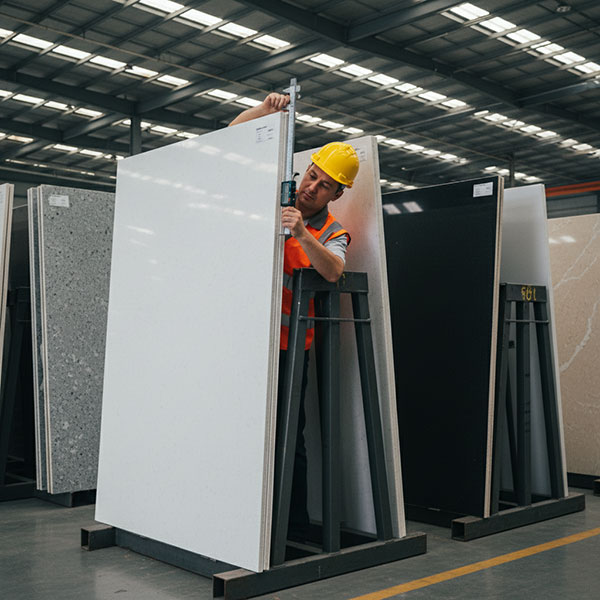
Each individual slab should have consistent thickness across its entire surface. Measure at a minimum of 9 points: four corners, four edge midpoints, and the center. Use a digital caliper with a minimum jaw depth of 50 mm. The variation within a single slab should not exceed 0.5 mm. If you find slabs with greater internal variation, this indicates problems with the Breton press calibration or uneven resin distribution during production — both of which can also affect the mechanical properties of the slab.
Batch-Level Consistency
All slabs within a production batch (typically identified by the same lot number) should fall within the stated tolerance. Sample at least 10% of slabs per bundle for thickness measurement during your quality inspection. If the factory is producing to a 20.0 mm target with ±0.5 mm tolerance, all measured slabs should fall between 19.5 and 20.5 mm. Document any slabs outside this range and request replacement.
Surface Flatness (Related to Thickness)
Beyond pure thickness, surface flatness (or "warp") is a related dimensional quality parameter. A slab may have correct average thickness but exhibit bowing, warping, or localized concavity/convexity. The maximum allowable bow for a 3200 × 1600 mm slab is typically 2–3 mm measured with a straight edge placed diagonally. Warped slabs create gaps against cabinet boxes, complicate seam joints, and indicate manufacturing process issues. Flatness problems are more common with 12 mm slabs (which are inherently less rigid) and with darker colors (which contain more resin and can be more susceptible to curing-related warpage).
1. Measure thickness at 9+ points per slab using a digital caliper. 2. Record all measurements on a slab-by-slab basis. 3. Check surface flatness with a 2 m straight edge on both faces. 4. Compare measured thickness to the factory's test report and the purchase order specification. 5. Photograph any non-conforming slabs with the caliper reading visible. 6. Report findings to the factory before authorizing container loading.
For buyers who cannot conduct in-person factory inspections, third-party inspection services such as SGS, Bureau Veritas, or Intertek operate throughout China's quartz manufacturing regions and can perform pre-shipment inspections following your specific quality criteria. The cost of a third-party inspection (typically $250–$500 per inspection day) is negligible compared to the cost of receiving a container of out-of-spec material at your overseas warehouse.
11. Choosing the Right Thickness & Finish Combination
With the technical foundations established, this section provides a practical decision framework organized by project type. The goal is to help B2B buyers — whether you are a slab distributor stocking inventory for resale, a project contractor sourcing for a specific job, or a developer specifying for a multi-unit build — identify the optimal thickness and finish combination that maximizes value for your specific context.
For Residential Countertop Distributors
If your business model involves importing quartz slabs for resale to local fabricators and kitchen dealers, your inventory strategy should be anchored in 20 mm polished. This specification satisfies 60–70% of end-consumer demand in most markets and provides the broadest color and pattern selection from manufacturers. Layer in 20 mm honed for the 15–20% of projects where architects or designers specify matte finishes — these are typically higher-value projects with better margins. For the premium tier, stock 30 mm polished in your top 3–5 bestselling marble-look patterns (Calacatta, Statuario, Carrera) to serve the luxury kitchen segment. Consider 12 mm only if you have significant demand for wall cladding projects or if you serve a market where thin-surface aesthetics are trending.
For Hospitality & Hotel Projects
Hotel projects are specification-driven. Before quoting, always request the brand's Material Performance Specification (MPS) or Design Standards Manual, which will detail exact thickness, finish, and testing requirements. As a general framework: economy and midscale brands (Holiday Inn Express, Fairfield, Hampton) specify 20 mm polished; upper-midscale and upscale brands (Courtyard, Hilton Garden Inn, DoubleTree) specify 20 mm polished or honed; and luxury brands (Ritz-Carlton, Four Seasons, St. Regis) may specify 30 mm polished or honed for public areas with 20 mm for guest room vanities. Wall cladding in lobbies and elevator interiors is almost universally 12 mm across all tiers.
For Multi-Unit Residential Development
Apartment and condominium developers optimize for cost across hundreds or thousands of units while maintaining a quality appearance that supports unit pricing. The standard approach is 20 mm polished in a curated selection of 3–5 colors that align with the project's 2–3 interior design schemes. Budget-sensitive developers are increasingly adopting 12 mm with laminated edges — this approach can reduce material cost by 15–20% and shipping cost by 25–30% compared to solid 20 mm, with no visible difference once installed. The cost savings across a 500-unit development can be substantial. However, this approach requires fabricators with proven laminated-edge capability, as a poor-quality lamination can be visible and undermines the perceived quality of the installation.
For Commercial Fit-Out & Retail
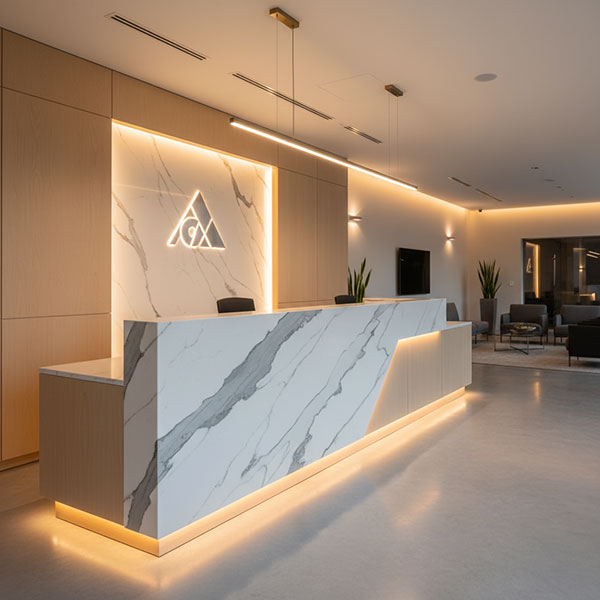
Commercial fit-out projects — offices, retail stores, restaurants, medical facilities — typically prioritize durability and ease of maintenance alongside aesthetics. 20 mm honed or leathered is an excellent specification for restaurant tables and bar tops, where the textured finish hides the inevitable marks of daily commercial use. Reception desks and cash wraps in high-end retail benefit from 30 mm polished for visual impact. Laboratory and healthcare surfaces should be 20 mm polished to maximize the hygienic, sealed surface characteristics and simplify cleaning protocols.
If you are sourcing for a specific project and need help determining the optimal thickness and finish combination, we offer complimentary specification assistance. Send your project details — including application type, total area, design intent, and target market — and our technical team will provide a tailored recommendation with CIF pricing to your port. Contact our team →
12. Frequently Asked Questions
Can I use 12mm quartz for kitchen countertops?
Yes, but with important caveats. 12 mm quartz requires a continuous support substrate (typically 18 mm plywood or the cabinet box surface itself) and is not suitable for unsupported overhangs exceeding 100–150 mm. Most fabricators apply a laminated buildup strip to the front edge to create the visual appearance of 20 mm or 30 mm thickness. When properly fabricated and installed, a 12 mm countertop with laminated edge is virtually indistinguishable from a solid 20 mm slab to the end user. The key advantage is the 15–20% material cost reduction and the significantly higher container loading density, which can reduce your total landed cost per square meter by 20–30%.
Is 30mm quartz twice as strong as 15mm?
Not exactly, but the relationship is more dramatic than a simple linear proportion. The flexural strength of a slab (its resistance to bending) is proportional to the square of the thickness — a principle derived from beam bending mechanics. So a 30 mm slab has approximately (30/15)² = 4× the bending resistance of a 15 mm slab, even though the flexural strength (in MPa) measured by a standard three-point bending test may only be 10–20% higher. The critical distinction is between the material property (MPa, which is relatively constant across thicknesses) and the structural capacity (total bending resistance, which increases with the square of thickness).
Does surface finish affect the price?
In most cases, polished is the base price and there is no additional charge for this finish. Honed finish is sometimes offered at the same price and sometimes carries a small premium (2–5%) because it requires additional quality control — achieving a consistent, uniform matte appearance across the entire slab is technically more demanding than achieving a uniform high gloss. Leathered finish typically carries a 5–10% premium due to the additional processing step and lower production throughput. Rough/flamed finishes are usually custom-order only and priced on a project basis.
What is the minimum order quantity (MOQ) for non-standard thicknesses?
Most Chinese manufacturers offer 12 mm, 20 mm, and 30 mm as standard thicknesses with flexible MOQs (often as low as 50–100 slabs). Non-standard thicknesses — 15 mm, 18 mm, and 25 mm are the most commonly requested — typically require a minimum production run of 200–500 slabs because the press and calibration lines must be reconfigured specifically for that thickness. Always discuss non-standard thickness requirements early in the quotation process, as the MOQ may significantly impact your order planning.
How does thickness affect warranty coverage?
Most reputable manufacturers offer a 10–15 year limited warranty for residential applications and a 5–10 year warranty for commercial applications, regardless of thickness. However, the warranty terms typically specify minimum installation requirements that vary by thickness — such as substrate support for 12 mm material and maximum unsupported spans. If the slab fails because it was installed outside of these parameters (e.g., a 12 mm slab overhanging 300 mm without support), the warranty claim may be denied. Always review the manufacturer's installation guidelines and warranty terms for each thickness and ensure your downstream fabricators and installers comply with them.
Can different thicknesses of the same color be mixed in one project?
Yes, and this is actually a recommended strategy for many projects. A common approach is to use 20 mm for countertop surfaces and 12 mm for matching backsplash panels and wall cladding within the same space. However, be aware that different thicknesses of the same color may exhibit slight visual differences due to the different production parameters — particularly in the depth and translucency of the color. Always request that the factory produce the different thicknesses in the same production run using the same batch of raw materials, and request cross-thickness color matching samples for your approval before bulk production begins.
For deeper technical information on engineered quartz stone properties and testing standards, we recommend consulting the following resources:
• Natural Stone Institute — Industry resources, technical guidelines, and fabricator training programs
• ASTM International — Full text of ASTM C1722 and related testing standards
• UL GREENGUARD — Indoor air quality certification database for verified products
• NSF International — Food safety and material certification resources