The Project: 800 Vanity Tops for a Premium Residential Tower
In Q3 2025, one of our Brazilian distribution partners approached us with a project that represented everything the Brazilian quartz market is becoming: large-scale, design-conscious, and logistically complex. A major São Paulo property developer was constructing a 32-story residential tower in the Pinheiros neighborhood — one of the city’s most desirable areas — and needed 800 custom vanity tops in Pure White quartz for the building’s 400 apartments, each featuring two bathrooms.
According to market data published by ABIROCHAS (Brazilian Association of Natural Stone), Brazil remains one of the most dynamic stone and engineered surface markets in Latin America, with strong demand from residential high-rise construction in São Paulo and Rio de Janeiro. Projects like this reflect the continued preference for durable, low-maintenance engineered surfaces in multi-unit developments.
The order itself was straightforward in concept: 800 identical rectangular vanity tops in a clean, classic Pure White quartz, pre-cut with single rectangular undermount sink cutouts. But as anyone who’s worked on large residential projects knows, the devil is always in the details — and in Brazil, the details extend well beyond the product itself to include import documentation, customs regulations, and the logistical challenge of getting heavy stone products from Guangdong to Santos port efficiently and affordably.
Material Selection: Why Pure White Won Over Marble-Look Options
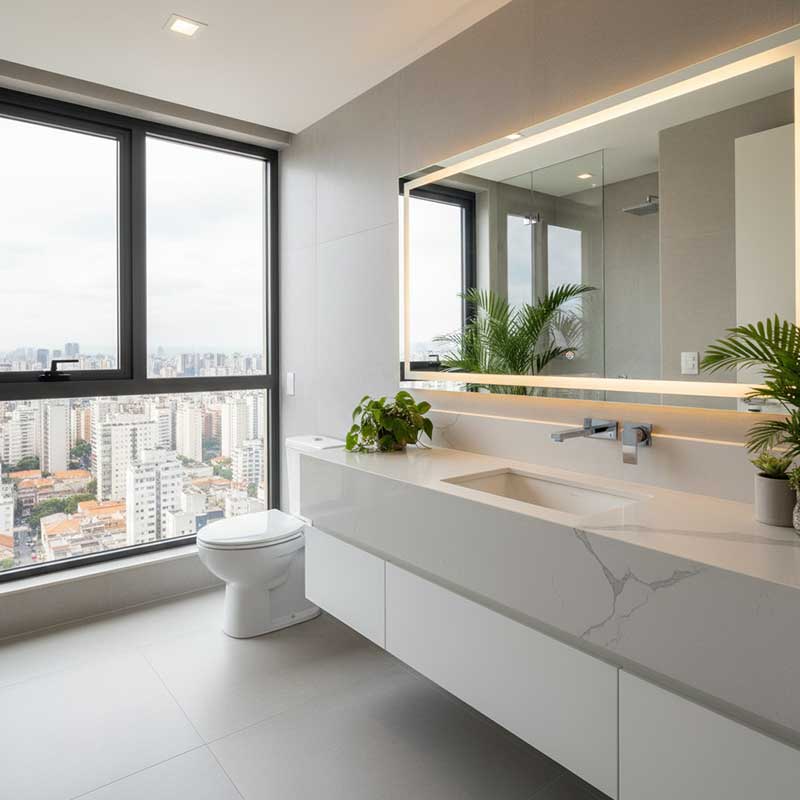
The developer initially considered a Carrara-style quartz with grey veining — which is popular in high-end Brazilian residential projects. However, after reviewing samples and discussing the project’s design direction with the interior architecture firm, the decision was made to go with our Pure White quartz instead. The reasoning reflects broader global interior design trends documented by organizations such as the American Society of Interior Designers (ASID), which highlight the growing demand for timeless, neutral surfaces that remain relevant beyond short-term design cycles.
The interior architects wanted the bathrooms to feel clean, serene, and timeless. They felt that veined marble-look quartz, while beautiful, could look dated within a few years as design trends evolve. Pure White, by contrast, is a neutral canvas that doesn’t tie the space to any particular trend moment. It pairs equally well with warm wood vanity cabinets, black hardware, or the colored tile accents that are popular in Brazilian bathroom design. It also photographs well for the developer’s marketing materials — another practical consideration that shouldn’t be underestimated in a competitive São Paulo property market.
The selected product was our standard Pure White quartz in 20mm thickness, polished finish. Dimensions for each vanity top were 1200×550mm with a 450×350mm undermount sink cutout centered at 600mm from each end.
Pre-Fabrication at Our Factory: 800 Pieces with Zero Tolerance for Inconsistency
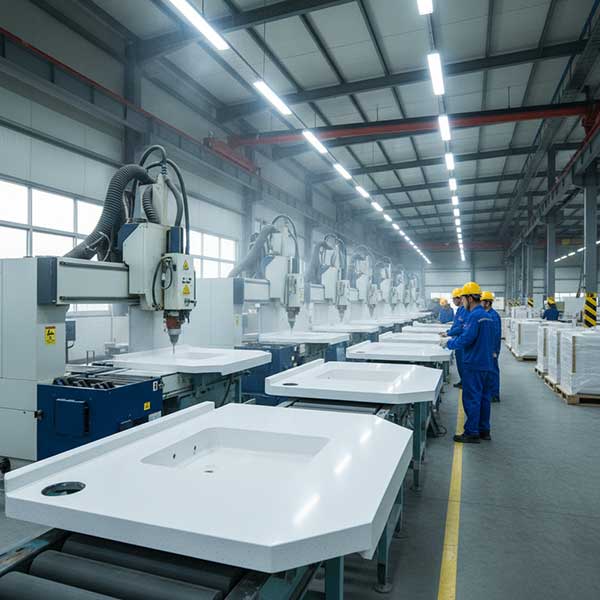
One of the key value propositions we offered on this project was complete pre-fabrication at our factory. Rather than shipping full slabs to Brazil and relying on local fabricators to cut 800 identical vanity tops — which introduces variability, waste, and additional cost — we CNC-cut all 800 pieces in our own facility using advanced stone processing equipment compliant with international manufacturing standards such as ISO 9001 quality management systems.
Dimensional Consistency
Our CNC machines are programmed to cut within ±0.5mm tolerance. When 800 pieces need to be identical — because they’ll be installed in 400 bathrooms by different installation crews over a period of several months — that level of precision eliminates the variability that would inevitably creep in if multiple local fabrication shops were cutting from slabs. The developer’s construction manager specifically requested factory pre-fabrication for this reason.
Reduced Waste and Lower Cost
Cutting vanity tops from full slabs at a local fabrication shop typically generates 15–25% material waste, depending on the slab size and the vanity dimensions. Our factory cutting process uses optimized nesting software common in advanced stone fabrication workflows, improving material yield and reducing waste. According to sustainability guidance from the Natural Stone Institute, improved fabrication efficiency plays a significant role in reducing embodied material waste in architectural stone applications.
For this order, our optimized nesting achieved an approximate waste rate of 8%. The cost per piece — including material, CNC cutting, edge profiling, and polishing — was approximately 18% lower than what the developer would have paid for local fabrication from imported slabs.
Polished Edge Finishing
All 800 vanity tops were finished with a front-facing eased (pencil round) edge, polished to match the top surface gloss. Back and side edges were calibrated but unpolished, as they would be concealed by the wall and vanity cabinet. Performing this edge work at the factory ensured consistent finish quality across all units while simplifying on-site installation.
Quality Control for 800 Identical Pieces
Quality control for this order was both straightforward and relentless. Because every piece was supposed to be identical, any deviation was immediately apparent. Our QC team inspected every single vanity top — not a sample, every one — checking dimensions, cutout placement, edge profile consistency, surface quality, and color match.
Engineered quartz used in export markets such as Brazil must also comply with applicable safety and performance standards. Industry testing protocols referenced by organizations such as ASTM International provide guidelines for physical performance and material testing of building products, which informed our internal quality benchmarks.
We flagged and replaced 23 pieces that showed minor defects: 11 with small edge chips from handling, 8 with slight dimensional deviations beyond tolerance, and 4 with visible surface marks. A rejection rate of 2.9% is typical for pre-fabricated pieces, and all 23 were replaced from the same production batch before packing began. The customer received exactly 800 Grade A pieces, packaged and ready for installation.
Logistics: Getting 800 Vanity Tops from Guangdong to São Paulo

The 800 vanity tops were packed into 5 forty-foot containers. Each vanity top was individually wrapped in foam sheeting, then packed vertically in custom wooden crates with internal dividers compliant with ISPM-15 international phytosanitary standards for wood packaging material. The packing density was approximately 160 vanity tops per container — optimized to maximize space utilization while maintaining adequate protection.
Transit and Documentation for Brazil
The ocean transit from Nansha port to Santos port took approximately 28 days via a transshipment connection in Singapore. Brazil is one of the more documentation-intensive markets we ship to. Required paperwork included a commercial invoice in both English and Portuguese, a detailed packing list with individual piece weights and dimensions, a certificate of origin certified by the Chinese Chamber of Commerce, and a fumigation certificate for the wooden crates.
Import procedures are regulated by the Receita Federal do Brasil (Brazilian Federal Revenue Service), and close coordination with the customer’s licensed customs broker ensured smooth clearance at Santos port.
Import Duties and Tax Considerations
Brazil applies import duties and federal/state taxes to engineered stone products under NCM classification codes. Tax components may include Import Duty (II), ICMS (state VAT), and PIS/COFINS federal contributions, depending on classification and transaction structure. Because Brazil’s total tax burden on imported building materials can be significant, factory pre-fabrication — which reduces total imported value compared to slabs plus local processing — can provide measurable cost advantages when structured correctly and in full compliance with Brazilian customs law.
On-Site Results and Client Feedback
The developer’s installation team began fitting vanity tops in November 2025, starting with the lower floors and working upward as the building neared completion. The feedback has been positive across the board. The construction manager commented that the dimensional consistency of the factory pre-cut pieces made installation “almost like assembling furniture” — each piece dropped into place without the on-site adjustments and shimming that locally fabricated pieces sometimes require.
The interior architecture firm was satisfied with the color consistency across all 800 pieces. Because they were all produced from the same raw material batch in a continuous production run, there was no visible color variation between apartments — which was a key concern given that prospective buyers would be comparing model units to actual delivered apartments.
The developer has since approached our Brazilian distribution partner about supplying vanity tops for two additional residential projects currently in the design phase — a strong indication that the quality, pricing, and logistics experience met their expectations.
Lessons for Buyers Considering the Brazilian Market
If you’re a quartz stone distributor or contractor working in Brazil, this project highlights several principles worth keeping in mind. Factory pre-fabrication for high-volume identical pieces offers significant cost savings, better consistency, and reduced local logistics complexity compared to importing slabs for local cutting. Documentation preparation is critical — start working with your customs broker and your supplier well before shipment. And finally, the Brazilian residential market continues to favor consistent, neutral designs such as Pure White and Super White for large-scale developments where long-term aesthetic relevance matters.