The Project: A World-Class Hotel in the Heart of Dubai Marina
When one of our long-standing UAE distributor partners reached out to us in mid-2025 with a briefing document for a new 5-star hotel project in Dubai Marina, we knew immediately that this would be one of the most demanding — and rewarding — orders we’d handle all year. The project was a 45-story mixed-use tower combining a 320-room luxury hotel with premium serviced residences, developed by one of Dubai’s most established real estate groups and managed by an internationally recognized hotel brand.
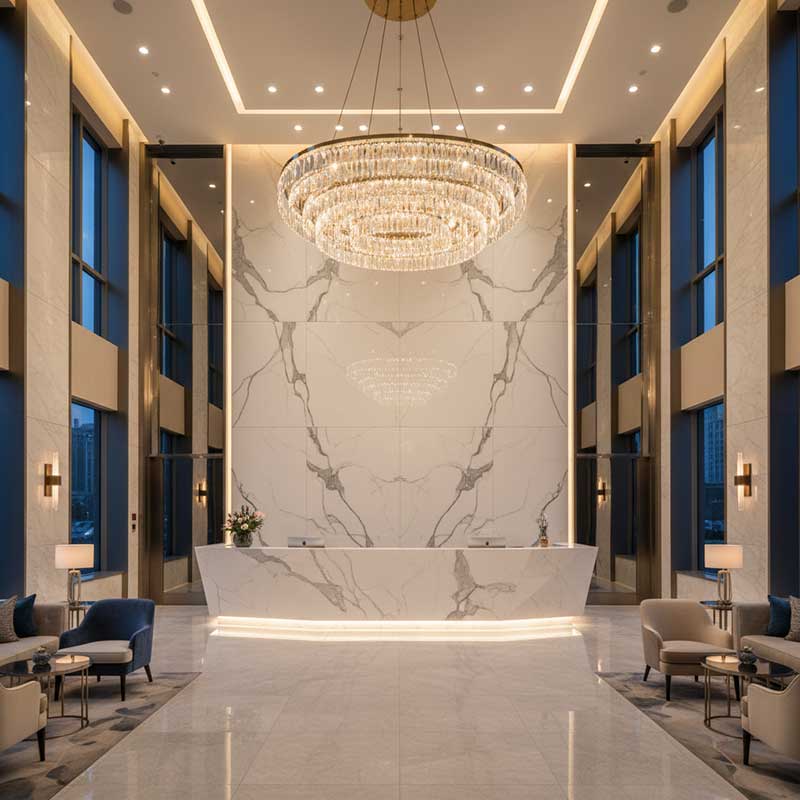
The scope of quartz surfaces required was significant: 480 bathroom vanity tops, elevator lobby wall cladding panels, a 12-meter reception desk in the main lobby, full-height wall cladding, restaurant and bar countertops across three F&B outlets, and spa treatment room surfaces — totaling approximately 3,200 square meters.
The Challenge: Consistency at Scale
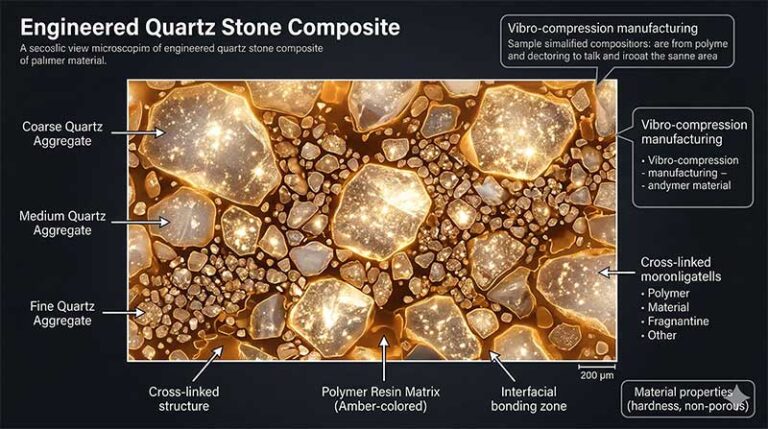
Maintaining visual consistency across 3,200 m² is one of the most complex challenges in large-scale surface supply. Even in engineered quartz manufacturing, small variations in aggregate blend, resin ratio, or pigment distribution can result in visible differences between production runs.
The hotel’s interior design firm specified a maximum ΔE color variation of 1.0 between slabs installed within the same line of sight. For context, ΔE is an industry-standard measurement of color difference defined by the International Commission on Illumination (CIE), which establishes global color measurement standards (Commission Internationale de l’Éclairage – CIE).
Additionally, the reception wall required vein continuity across adjacent slabs to create the visual impression of a single, monolithic stone installation.
Our Production Strategy
To meet these standards, we dedicated an 18-day continuous production run using a single calibrated batch of raw materials. All slabs were manufactured under identical process parameters to minimize variation. Our vein programming team developed a controlled sequence to allow visual flow between slabs intended for bookmatched or adjacent installations.
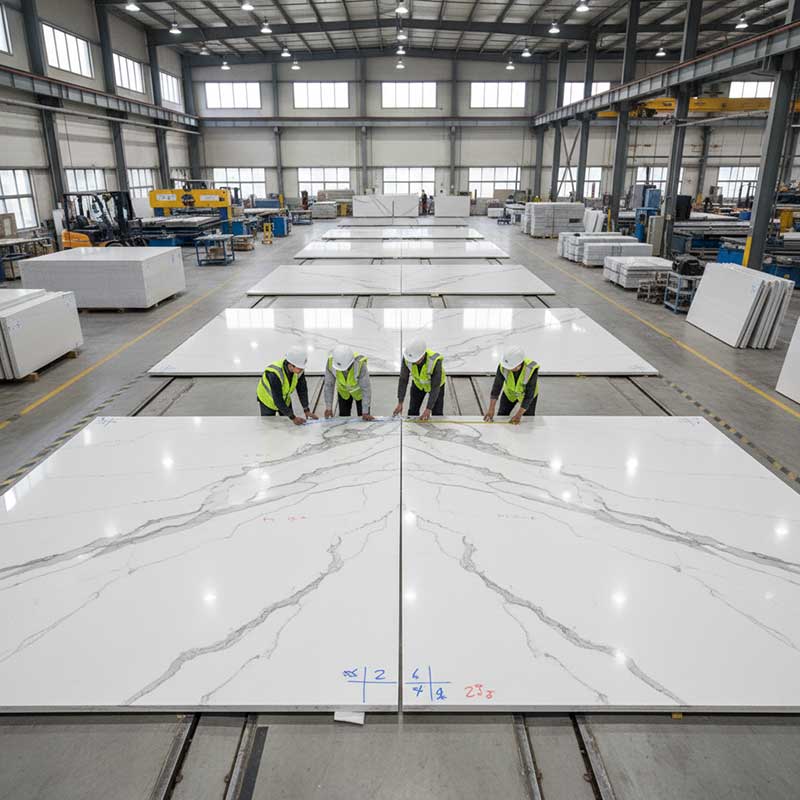
Post-production, representative slabs from each batch were physically dry-laid and measured using spectrophotometry equipment. The final measured average ΔE was 0.7, with no pair exceeding 0.95 — fully compliant with the project’s design specification.
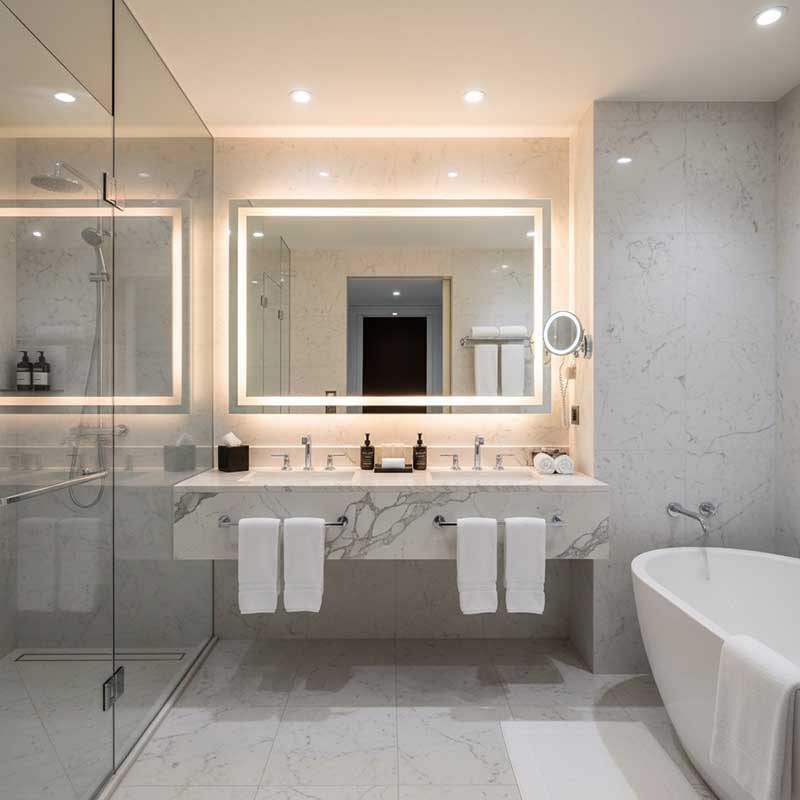
Vanity Tops: 480 Identical Pieces
The 480 vanity tops required strict interchangeability. Each piece was CNC-cut to 1200×550×20mm with identical sink cutouts and polished edges. All tops were sequentially fabricated, individually labeled, and mapped to designated hotel rooms to eliminate on-site sorting and reduce installation risk.
Restaurant and Bar Countertops: Food-Safety Compliance
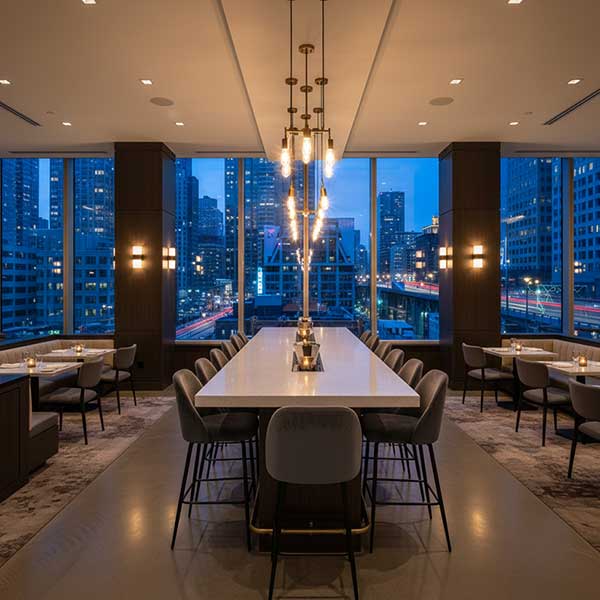
All F&B countertops were manufactured using quartz certified under NSF/ANSI 51 standards for food equipment materials. This certification confirms that the surface is non-porous, safe for food contact, and compliant with commercial hospitality requirements. Documentation for the exact production batch was included with the project shipment.
Logistics: Phased Delivery Strategy
The full 3,200 m² order shipped in eight 40-foot containers under a phased schedule aligned with the construction timeline. Lobby and F&B surfaces shipped first in September 2025, followed by vanity tops and elevator panels in October 2025. This staging minimized on-site storage risk and improved installation sequencing efficiency.
The Outcome: Delivered January 2026
The hotel officially opened in January 2026. All quartz surfaces were installed without slab rejection or replacement. The design firm signed off on color consistency, and the hotel operator approved all food-safety documentation without revision.
This project reaffirmed a key principle in large-scale hospitality supply: consistency is not accidental — it is engineered through controlled production runs, documented layout planning, precision fabrication, and proactive technical support.
For hospitality and commercial projects requiring high-volume quartz supply with tight tolerance control, dedicated production planning is not optional — it is essential.